
Impact of Rural Settlements on Groundwater Quality in the Semiarid Pishin Basin, Balochistan, Pakistan
-
Adnan Khan


Department of Geology, University of Karachi, Karachi, Pakistan
Syed Wasi HaiderInstitute of Space Science and Technology, University of Karachi, Karachi, Pakistan
NaimatullahDepartment of Geology, University of Karachi, Karachi, Pakistan
| Received 20 Feb, 2026 |
Accepted 17 Jul, 2026 |
Published 30 Sep, 2026 |
Background and Objective: Groundwater is the main water source in the semiarid Pishin Basin, supporting drinking and agriculture. However, rural settlements with poor sanitation and waste management are increasingly degrading its quality. This study evaluates the hydrochemical characteristics and controlling mechanisms of groundwater in the Pishin Basin, a semi-arid alluvial aquifer system. Materials and Methods: Groundwater and agricultural soil samples were collected from the semiarid Pishin Basin, Pakistan, during October-November 2024. Physicochemical parameters, including major cations and anions, were analyzed using standard analytical methods in the Department of Geology, University of Karachi. All analyses were performed in triplicate with appropriate quality control and standardization procedures. Descriptive statistical analysis was conducted using SPSS 2022, and the obtained results were compared with WHO 2011 drinking water guidelines. Results: Groundwater is neutral to slightly alkaline (pH 7.4-8.0) and moderately warm (24.5-28.8°C), reflecting shallow circulation under semi-arid conditions. Total dissolved solids (177-2200 mg/L; mean 1032 mg/L) and hardness (340-1000 mg/L) indicate fresh to slightly saline water, with some samples exceeding WHO limits. The cation chemistry is dominated by Ca2+ and Mg2+ from carbonate weathering, while Na+ over Cl– suggests silicate weathering and ion exchange. Bicarbonate is the main anion, with sulphate from gypsum and anhydrite dissolution. Elevated nitrate and potassium in selected locations indicate minor anthropogenic influence from fertilizers and organic waste. Conclusion: Groundwater chemistry in the Pishin Basin is primarily controlled by natural geochemical processes, including carbonate and silicate weathering, ion exchange reactions, and evaporation under semi-arid conditions, with minor anthropogenic impacts. While most parameters are within acceptable limits, localized exceedances of TDS, hardness, potassium, and nitrate highlight the need for continuous groundwater monitoring to ensure sustainable water quality management.
| Copyright © 2026 Khan et al. This is an open-access article distributed under the Creative Commons Attribution License, which permits unrestricted use, distribution, and reproduction in any medium, provided the original work is properly cited. |
INTRODUCTION
The study of groundwater in alluvial aquifers of arid regions is important because these aquifers often serve as the primary and most dependable source of water in areas where surface water is scarce or highly seasonal1. Low rainfall, high evaporation rates, and limited recharge make groundwater systems in arid environments particularly vulnerable to over-extraction and long-term depletion2. Alluvial aquifers are generally shallow and highly permeable, which enhances their productivity but also increases their susceptibility to contamination from agricultural return flows, urban wastewater, and natural geochemical processes3. Comprehensive groundwater studies are therefore essential to understand aquifer properties, recharge mechanisms, water quality evolution, and flow dynamics, supporting safe drinking water supply, sustainable irrigation practices, public health protection, and effective groundwater management under increasing water demand and climate stress4.
Water, air, and soil, being a part of the natural environment and ecosystem, express the studied environment worldwide, while water occurs to be one of the crucial natural resources for the existence of all organisms around the globe5,6. About every year, around 5.9 to 7.9 million people die due to diseases related to water like typhoid, diarrhea, skin disease, cholera, and kidney disease, as well as gastrointestinal disorders. The demand for fresh water appears to be increasing exponentially due to human intervention6. A commission based on pollution and health by The Lancet that discusses pollution as the leading global environmental cause of premature death as well as diseases, where water pollution appears to cause infant mortality7. The pollution mitigation points related to hazards for human beings were addressed in the Global Action Plan8, where different types of pollutants were also considered. Around the world, water and soil act as the main nutrient providers for human health and daily activities. The soil itself provides nutritious food with safety, exhibits vitality of ecosystem services, and its degradation will eventually affect the global population if not mitigated9,10. Unlike water that creates waterborne diseases, soil pollutants often consists of pesticides, chemicals of synthetic nature, heavy metals, plastic wastes, as well as pathogens. They originate from fossil fuels, transport, mining, and agricultural activities, whilst water pollution produces cation, anion, and organic matter, reducing bacteria11, causing consumers to be exposed to contamination implicitly and explicitly during potable uses. Natural and anthropogenic activities cause excessive exploitation of these resources.
It is important to assess the natural resources provided by the environment, whether it is observed in arid, semiarid, tropical, or subtropical climate regions. The majority of semiarid locations located in India are exceeding drinking water guidelines given by the World Health Organization, as total geographical locations are under immense pressure due to climate change. It has affected soil conditions in both arid and semiarid environments. The increase in groundwater abstraction in irrigation locations also increases the salinity of groundwater itself12. Assessing groundwater quality is important for environmental assessment, providing its worldwide use for various agricultural, domestic, and industrial purposes. Its assessment in various consuming applications decides its importance in numerous household and industrial applications8,13.
Groundwater quality assessment in the Pishin Basin, Pakistan, is critically important because groundwater is the primary source of water for drinking, agriculture, and livestock in this arid region with limited surface water availability. Rapid population growth, expansion of agriculture, and excessive groundwater extraction have increased the risk of water quality deterioration through salinity, hardness, and the mobilization of harmful constituents such as fluoride, nitrate, and other dissolved salts. Poor groundwater quality poses serious threats to public health, agricultural productivity, and soil sustainability, while natural geological processes and inadequate sanitation further contribute to contamination risks. Therefore, regular groundwater quality assessment is essential for ensuring safe drinking water, protecting human health, supporting sustainable agriculture, and guiding effective water resource management and policy
planning in the Pishin Basin. There was excessive scarcity and abstraction of water resources in 200714. Another study in the district Pishin revealed that farmers are using traditional irrigation methods that are not water efficient, and they grow water-intensive crops15. Usually, practice performed by local farmers during irrigation purpose led in reduction of water levels with more salinization if deeper aquifers are added up. As a result, two issues arises, one leads to water salinization while the other damages crop yield due to crop sensitivity to the different chemical composition of salinized water. No work has been carried out so far on the groundwater quality of the Pishin basin being used by the rural population for domestic purposes. Hence, this study aims to evaluate the quality of groundwater using the physicochemical analysis technique. It also aims to identify key factors influencing their health through drinking such water.
MATERIALS AND METHODS
The Pishin basin is located in a semiarid environment. Agricultural soil and groundwater samples were collected during October to November 2024. The procedure consists of soil sampling from agricultural lands where solar panel-based groundwater tube wells were located. The groundwater samples were also collected in polyethylene bottles of 1 litre capacity. For preservation and collection of groundwater in case of nitrate determination, sample bottles of around 250 mL capacity were taken, and boric acid solution was added to preserve nitrate from the start of the field sampling site till the laboratory. The analysis was carried out according to defined methods16. The analysis for cations and anions in groundwater and agricultural soils was carried out in the Department of Geology, University of Karachi. The following (Table 1) shows materials and methods for the analysis of both groundwater and soil samples.
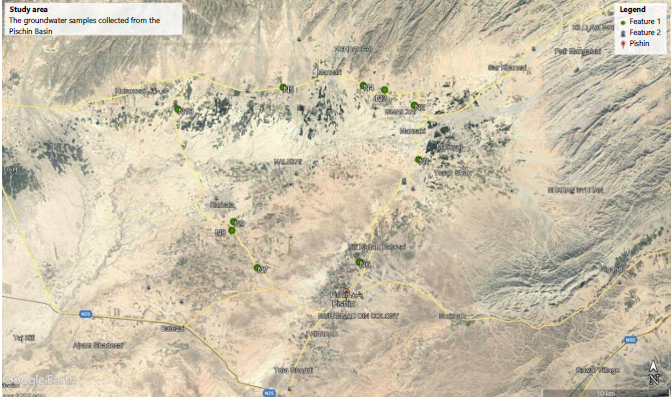
Study area: The Pishin is a district in the Northeastern part of Baluchistan, Pakistan. It shares borders with Afghanistan, Zhob, and Quetta. The Geographical coordinates of the area are 30.7383° N, 67.2848° E, as shown in Fig. 1 and Table 2. The district features possess diverse topography, including mountains, plains, and valleys. The fertile Pishin Valley is known for its cultivation where it is a prominent agricultural land where agriculture is a major economic activity. Livestock farming is also significant source of income. Summers are hot with temperatures often exceeding 40°C (104°F) whilst winters are relatively cool, with temperatures dropping, and occasional frost or freezing temperatures. The Pishin lies outside the sphere of monsoon currents17,18.
The Pishin Basin is characterized by a predominantly rural setting, with settlements distributed in small towns, villages, and scattered agricultural communities. The population largely depends on groundwater-based agriculture, livestock rearing, and related activities for livelihoods, reflecting the basin’s agrarian economy. The Pishin town functions as the main urban center, providing administrative, commercial, and social services, while the surrounding areas remain sparsely populated. Population growth, rural-to-urban migration, and expansion of cultivated land particularly orchards have increased pressure on groundwater resources for domestic and irrigation use. Limited infrastructure for water supply, sanitation, and waste management in many rural areas further influences living conditions and has implications for groundwater quality and sustainability in the basin.
The population is concentrated in the Pishin town and dispersed villages resting mainly over alluvial deposits, where shallow and deep aquifers are most accessible. The local population relies heavily on groundwater for domestic supply, irrigation, and livestock, leading to intensive abstraction through dug wells and tube wells. Rapid population growth, agricultural expansion particularly fruit orchards and unplanned settlement development have increased stress on the alluvial aquifer system, contributing to declining water tables and potential water quality deterioration. Inadequate sanitation facilities and waste disposal practices in rural and peri-urban areas further pose risks of aquifer contamination.
|
| Table 1: | Physical and chemical parameters of soil and groundwater collected from the studied environment | |||
| Parameter | Instruments/Equipment |
| Odor and taste | Aesthetically |
| Eh (mv)/ORP and pH | ADWA(AD111) pH meter |
| Color | Aesthetic (visual method) |
| Temperature | ADWA(AD330) TDS/EC/T°C meter |
| Turbidity | Hanna HI93703 turbidity meter |
| TDS/EC | ADWA(AD330) TDS/EC/T°C meter |
| Hardness | EDTA titration method25 |
| Chloride | Argentometric titration method16 |
| Bicarbonate | Argentometric titration method16 |
| Nitrate | Genesys 10s Uv-Vis spectrophotometer16 |
| Sulphate | Gravimetric method16 |
| Sodium | JENWAY PFP7 flame photometer |
| Potassium | JENWAY PFP7 flame photometer |
| Calcium | EDTA titration method16 |
| Magnesium | Standard Method16 |
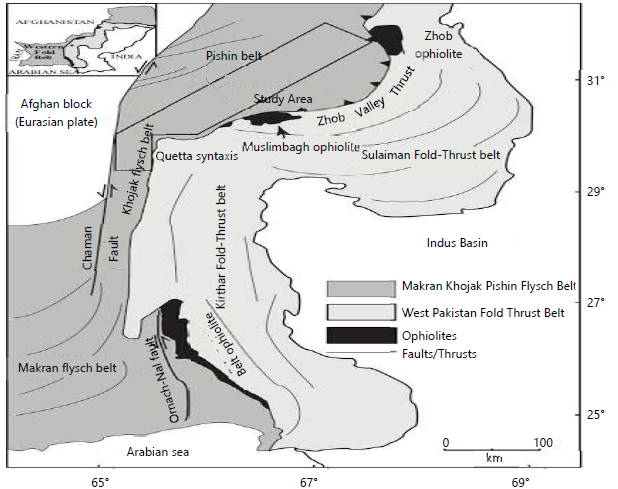
Geological setting: The Pishin Basin forms the western sideline of the Indo-Pakistan Plate in Pakistan. It is located within the Baluchistan province, comprising limestone, interbedded sandstone, ophiolite suites, and conglomerates. Its vicinity exposes sinisterly Chaman Fault, Zhob Thrust Valley (ZVT), Main Boundary Thrust (MBT) that arrange themselves towards the Makran area19. Its structural style is more intricate and dynamic, with synclines and anticlines20, as India-Eurasia collision zone occurs along with the Kirthar Suleiman fold and thrust belt. The Pishin Basin is more than 700 km long and 39 to 174 km wide between the Zhob-Kabul as well as Khuzdar-Quetta regions. It further extends to the Main Karakoram Thrust (MKT) situated in the North and the Makran subduction zone in the South. The Pishin basin developed in the region known as the plate margin during the Tertiary period, where the Afghan block and the Indian plate collided20. The Chaman fault and an island arc collision resulted in the obduction of ophiolites in the early Tertiary period, which are the tectonic events, influencing the basin. The sediments (mainly clastics) were derived from the rising mountains of the Kabul Afghan blocks. The flysch-type sediment fill was moulded into narrow, sharp, often faulted and lengthened anticlines and comparatively open synclines during the Quaternary collision phase. The overall movement of the folds and faults is arcuate and parallel to the sinuate fold belt, as shown in Fig. 2.
|
| Table 2: | Geographical coordinates of collected groundwater samples from the Pishin District, Baluchistan, Pakistan | |||
| Sample codes | Latitude | Longitude |
| N1 | 30.687401° | 67.070742° |
| N2 | 30.726595° | 67.067113° |
| N3 | 30.737647° | 67.042110° |
| N4 | 30.740820° | 67.025205° |
| N5 | 30.739539° | 66.957575° |
| N6 | 30.613513° | 67.021845° |
| N7 | 30.609324° | 66.935881° |
| N8 | 30.636193° | 66.914528° |
| N9 | 30.642521° | 66.915995° |
| N10 | 30.723793° | 66.869184° |
Quality control and replication: Before descriptive and detailed analysis, collected groundwater samples were analyzed for chemical and physical variables with 3 replicates, and the mean was considered, as well as standardization of EDTA through calcium carbonate, silver nitrate standardization through analytical grade sodium chloride and standardization of hydrochloric acid was prepared through sodium hydroxide. All the above standardizations are useful for appropriate concentration measurements of anions and cations, including Scharlau standard solutions of sodium and potassium for the flame photometer and nitrate standard solutions for detecting the quantitative value of nitrate of given samples through spectrophotometer16,21.
Data analysis: The collected groundwater samples from the Pishin Basin were further assessed using SPSS 2022 statistical software for descriptive statistical analysis. The WHO 2011 drinking water guidelines were used to compare and visualize the collected samples with their corresponding mean values presented in Table 2.
RESULTS AND DISCUSSION
Physical characteristics: The physicochemical parameters of groundwater samples (N =10) have been summarized in Table 2. Data reveal that the groundwater temperature ranges from 24.5 to 28.8°C, with a mean value of 24.6±0.11°C, reflecting the semi-arid climatic conditions and shallow alluvial aquifer setting of the study area, as further illustrated by spatial interpolation maps11. On the other hand, groundwater pH is neutral to alkaline (range: 7.4-8.0, mean: 7.7), which is within the permissible limit (6.5-8.5) of WHO (2011) for drinking purposes. This slight pH condition suggests that the groundwater system is generally in equilibrium with slight intermittent mixing of surface water11,22. The observed near-neutral to slightly alkaline pH reflects carbonate buffering within the alluvial aquifer sediments of the Pishin Basin, suggesting a groundwater system that is generally in geochemical equilibrium. Such pH conditions are characteristic of arid and semi-arid alluvial aquifers, where episodic recharge from surface water during rainfall events results in limited but intermittent surface groundwater mixing11,22. Likewise, Eh values span between -50 to +179 mv indicating the prevalence of slightly oxic environment, where only one sample showed a negative value (-50 mv), which is attributed to the localized reducing conditions induced by sewage or organic matter input, which promotes oxygen consumption and redox lowering in shallow groundwater environments common to arid basins1,22,23.
The total dissolved solids (TDS) content varies between 177 to 2200 mg/L, with a mean value of 1032 mg/L. The mean normalized TDS content is within the permissible limit of Pakistani Guidelines (1000 mg/L) but exceeded the WHO (2011) recommended guideline limit of 500 mg/L for drinking water, indicating a predominantly fresh to slightly saline character of the groundwater samples. The elevated TDS levels reflect the influence of water rock interaction under the prevailing geological setting, where both mineral dissolution and precipitation processes govern groundwater chemistry24,25. In addition, recent years have witnessed unexpected declines in both groundwater and surface water resources, likely linked to climatic variability and increased anthropogenic pressure, further intensifying solute concentrations in arid and semi-arid aquifer systems11. Total hardness of the groundwater samples ranges from 340 to 1000 mg/L, with a mean value of 622±252.70 mg/L, slightly exceeding the WHO (2011) permissible limit of 500 mg/L for drinking water. Such elevated hardness reflects substantial contributions from calcium and magnesium, commonly associated with carbonate-rich alluvial sediments in semi-arid aquifer systems.
Chemical characteristics
Major cations: Sodium concentrations vary between 40 and 254 mg/L, with a mean of 151±85.63 mg/L, and remain largely within the WHO (2011) guideline value of 200 mg/L in Table 3. In contrast, potassium concentrations ranged from 15 to 174 mg/L, with a mean of 52±47.19 mg/L, significantly exceeding the recommended limit of 12 mg/L. The elevated concentration of potassium, coupled with hardness values suggest dominance of shallow groundwater circulation rather than deeper confined systems. Increased potassium concentrations are primarily attributed to intense silicate weathering of K-bearing minerals such as feldspars, micas, and clay minerals within the alluvial sediments, a process enhanced in shallow aquifers under semi-arid conditions. Limited recharge, high evaporation rates, and prolonged water–rock interaction further concentrate potassium in groundwater. In addition, anthropogenic inputs such as agricultural fertilizers and domestic wastewater infiltration may locally augment potassium levels, particularly in near-surface groundwater systems26,27.
A similar trend is observed for divalent cations (Ca2+ and Mg2), where calcium concentrations ranged between 24 and 208 mg/L, with a mean value of 84±59.20 mg/L, exceeding the WHO (2011) guideline value of 75 mg/L for drinking water. Likewise, magnesium concentrations varied between 63.18 and 155.52 mg/L, with a mean of 100.18±34.93 mg/L, surpassing the recommended limit of 50 mg/L26. The enrichment of Ca2+ and Mg2+ is attributed to dissolution of carbonate minerals such as calcite and dolomite within the alluvial aquifer sediments, coupled with prolonged water rock interaction under semi-arid climatic conditions, which collectively contribute to elevated groundwater hardness11,12. The Pishin Basin is dominated by alluvial sediments derived from surrounding carbonate and silicate rocks, including dolomitic limestone. Dolomite [CaMg(CO3)2] dissolves to release magnesium and calcium in roughly equal proportions, but the Mg2+/Ca2+ ratio in groundwater can be elevated if dolomite-rich layers are more prevalent or more reactive than calcite-rich layers. Similarly, local differences in mineralogy (dolomite vs calcite dominance) can make Mg2+ more mobile than Ca2+ in groundwater.
| Table 3: | Descriptive statistics of collected groundwater samples from study area | |||
| Variables | WHO (2011) | Mean | Minimum | Maximum | Std. Deviation | Analysis N |
| pH | 6.5-8.5 | 7.68 | 7.38 | 8.01 | 0.24 | 10 |
| Eh/ORP (mv) | - | 99 | -50 | 179 | 89.8 | 10 |
| TDS (mg/L) | 500 | 1032 | 177 | 2200 | 726 | 10 |
| Temp (°C) | - | 24.6 | 24.5 | 24.8 | 0.11 | 10 |
| Hardness (mg/L) | 500 | 622 | 340 | 1000 | 252.7 | 10 |
| Sodium (mg/L) | 200 | 151 | 40 | 254 | 85.63 | 10 |
| Potassium (mg/L) | 12 | 52 | 15 | 174 | 47.19 | 10 |
| Calcium (mg/L) | 75 | 94 | 24 | 208 | 59.2 | 10 |
| Magnesium (mg/L) | 50 | 100.18 | 63.18 | 155.52 | 34.93 | 10 |
| Chloride (mg/L) | 250 | 234.49 | 14.29 | 600.53 | 213.38 | 10 |
| Bicarbonate (mg/L) | 300 | 376 | 120 | 760 | 193.4 | 10 |
| Nitrate (mg/L) | 10 | 40.71 | 4.7 | 276.21 | 83.23 | 10 |
| Sulfate (mg/L) | 250 | 179.5 | 92 | 267 | 50.51 | 10 |
In arid/semi-arid regions like the Pishin, evaporation increases ionic concentrations, and Mg2+ often remains in solution longer than Ca2+, which can precipitate as calcite when water becomes slightly supersaturated. It is well established that the Mg2+ solubility is generally higher than Ca2+ under the same conditions, especially when pH is near-neutral to slightly alkaline (as observed in the Pishin). Similarly, shallow groundwater is more exposed to rapid silicate weathering (feldspars, amphiboles, pyroxenes) that can release additional Mg2+. In contrast, Ca2+ may be partially removed by calcite precipitation or ion-exchange reactions in the aquifer matrix. On the other hand, some Mg2+ can also come from fertilizer use, sewage, or irrigation return flow, especially in shallow wells, enhancing the Mg2+ concentration locally relative to calcium. Elevated Mg2+ compared to Ca2+ is often reflected in Mg2+/Ca2+ ratios >1, which is typical of dolomitic aquifers or regions influenced by silicate weathering rather than pure calcitic systems5,22,28.
Chloride concentrations in the collected groundwater samples ranged from 63.18 to 155.52 mg/L, with a mean value of 100.18±34.93 mg/L. These values remain well below the WHO (2011) guideline limit of 250 mg/L for drinking water, indicating minimal anthropogenic influence, consistent with the sampling locations being situated in areas of sparse agricultural activity and limited human settlements (Fig. 1). The relatively low chloride levels suggest that natural geochemical processes, rather than contamination from fertilizers, sewage, or irrigation return flow, primarily control the groundwater chemistry in these semi-arid alluvial aquifers11,22. Sodium is released not only from halite (NaCl) dissolution, but also from weathering of silicate minerals (e.g., albite, feldspars, and clays). Whereas, chloride primarily comes from halite dissolution or anthropogenic sources (sewage, fertilizers), which are limited in sparsely populated areas like the Pishin. Hence, Na can accumulate independently of Cl–, leading to Na+>Cl–. On the other hand, sodium can be mobilized through cation exchange in clays or alluvial sediments, replacing Ca2+ and Mg2+ on the exchange sites. Consequently, this process adds Na+ to groundwater without a corresponding Cl– increase, further increasing the Na+/Cl– ratio. In semi-arid climates, evaporation concentrates cations in shallow groundwater. Mg2+,Ca2+, and Na can become enriched, but Cl may be more mobile and flushed during rare recharge events. The lower Cl content also reflects minimal sewage, fertilizer, or irrigation return flow, whereas Na from natural silicate weathering and ion exchange continues to accumulate, producing the observed difference.
The bicarbonate (HCO3– ) content in groundwater samples of study area ranged from 120 to 760 mg/L, with a mean value of 376±193.40 mg/L, reflecting the dissolution of carbonate minerals from the local geology, particularly calcareous limestone in this sedimentary basin. Bicarbonate in groundwater primarily originates from carbonate mineral dissolution, such as calcite (CaCO3) and dolomite (CaMg(CO3)2), which are abundant in the Pishin Basin’s sedimentary rocks and alluvial deposits. When CO from soil respiration or atmospheric sources dissolves in infiltrating water, it forms carbonic acid (H2CO3), which reacts with carbonate minerals and dissolves to form bicarbonate29-31. The semi-arid climate promotes evaporation and limited flushing, which can concentrate bicarbonate along with other ions in shallow alluvial aquifers. Slightly alkaline pH values (~7-8) in the study area further favour the stability of HCO3– in solution, preventing it from converting to carbonate (CO32– ) or precipitating as calcite. Generally, elevated HCO3– content is associated with high calcium and magnesium levels, contributing to temporary water hardness. It also balances the ionic charge in the aquifer, maintaining groundwater electroneutrality alongside Na+, K+, Cl–, and SO42–. In addition, high bicarbonate reflects water rock interaction dominance rather than anthropogenic contamination. Hence, groundwater chemistry is largely controlled by natural geogenic processes in terms of carbonate dissolution in the sedimentary basin of the Pishin.
Nitrate (NO3–) concentrations vary between 4.70 and 276.21 mg/L, with a mean of 40.71±83.23 mg/L, indicating localized anthropogenic influence, primarily from the application of organic fertilizers and agricultural runoff in the study area11. Nitrate is highly mobile and reactive in the soil water system. Even small amounts of fertilizers, animal waste, or sewage can rapidly increase nitrate concentrations in shallow groundwater. It is water-soluble and moves easily with recharge water, so localized agricultural or organic waste inputs can create spikes in nitrate even if chloride remains low. Nitrate mainly infiltrates shallow aquifers, while chloride may require either long-term mineral dissolution or significant anthropogenic inputs to increase. Since the Pishin groundwater samples are largely shallow, nitrate from fertilizer use is more detectable than chloride from human activity.
Sulfate (SO42–) concentrations in the groundwater samples range from 92 to 267 mg/L, with a mean of 179.5±50.51 mg/L. Most samples fall below the WHO (2011) guideline limit of 250 mg/L, indicating that the groundwater is largely suitable for drinking with respect to sulfate content, although a few localized areas slightly exceed this value. These levels likely result from the dissolution of sulfate-bearing minerals such as gypsum and anhydrite, with minor anthropogenic contributions, reflecting the hydrochemical characteristics of semi-arid alluvial aquifers in the region11,22,30,31. The occurrence of sulfate in the study area is primarily attributed to the dissolution of naturally occurring sulfate-bearing minerals such as gypsum (CaSO4·2H2O) and anhydrite (CaSO4) within the alluvial and sedimentary aquifer deposits. This mineral dissolution is enhanced by slightly acidic groundwater conditions due to CO2 from soil respiration, which increases the solubility of sulfate minerals. Minor anthropogenic contributions, such as fertilizer application, livestock effluents, and domestic wastewater, may also locally elevate sulfate concentrations, although their influence is limited in sparsely populated or low-agriculture zones. Elevated sulfate levels are consistent with the semi-arid hydrochemical environment, where limited recharge and high evaporation rates concentrate ions in shallow aquifers. Spatial distribution of sulfate also reflects the influence of aquifer lithology, groundwater flow paths, and the degree of water rock interaction, which collectively control the hydrochemical evolution of the alluvial groundwater system11,22,30-37.
CONCLUSION
The hydrochemical analysis indicates that groundwater in the Pishin Basin is predominantly controlled by natural geochemical processes, including carbonate and silicate weathering, water rock interactions, and ion exchange, under semi-arid conditions. Minor anthropogenic influences are observed in nitrate and potassium, while most other parameters reflect the geogenic signature of the alluvial and sedimentary aquifers. Overall, the groundwater is largely suitable for domestic and irrigation purposes. However, localized exceedances of TDS, hardness, potassium, and nitrate highlight the need for regular monitoring to ensure sustainable water quality management in the basin.
SIGNIFICANCE STATEMENT
This study provides a comprehensive assessment of groundwater quality in the semi-arid Pishin Basin, where rural settlements and agricultural activities increasingly influence water resources. The findings highlight the dominance of natural geochemical processes in controlling groundwater chemistry, while also identifying localized anthropogenic impacts on key parameters such as nitrate and potassium. The results offer important baseline information for water resource managers and policymakers to support sustainable groundwater use, mitigate contamination risks, and ensure safe drinking water supply in arid and semi-arid regions.
REFERENCES
- Freeze, R.A. and J.A. Cherry, 1979. Groundwater. Prentice-Hall, New Jersey, United States, ISBN: 9780133653120, Pages: 604.
- Custodio, E., 2002. Aquifer overexploitation: What does it mean? Hydrogeol. J., 10: 254-277.
- Todd, D.K. and L.W. Mays, 2004. Groundwater Hydrology. 3rd Edn., John Wiley and Sons, Hoboken, United States, ISBN: 9780471059370, Pages: 656.
- Elfert, M., 2015. UNESCO, the faure report, the delors report, and the political utopia of lifelong learning. Eur. J. Educ., 50: 88-100.
- Zahid Ullah, M.A. Talib, Abdur Rashid, J. Ghani and A. Shahab et al., 2021. Hydrogeochemical investigation of elevated arsenic based on entropy modeling, in the aquifers of District Sanghar, Sindh, Pakistan. Water, 13.
- Yadav, A.K., Anita, M. Kumar, K.P. Raw and N. Kumar, 2025. Deciphering geospatial variations in water quality of a perennial river for human consumption and agricultural application. Water Pract. Technol., 20: 221-238.
- Landrigan, P.J., R. Fuller, N.J.R. Acosta, O. Adeyi and R. Arnold et al., 2018. The Lancet commission on pollution and health. Lancet, 391: 462-512.
- El Mountassir, O., M. Bahir, S. Hakimi, T.K. Faraj and P.M. Carreira, 2024. Assessment of groundwater quality in the semi-arid environment: Implications of climate change. Limnological Rev., 24: 520-542.
- Münzel, T., O. Hahad, J. Lelieveld, M. Aschner, M.J. Nieuwenhuijsen, P.J. Landrigan and A. Daiber, 2025. Soil and water pollution and cardiovascular disease. Nat. Rev. Cardiol., 22: 71-89.
- FAO, 2021. Global Assessment of Soil Pollution: Summary for Policymakers. Food and Agriculture Organization, Rome, Italy, ISBN: 9789251344484, Pages: 84.
- Haider, S.W., S.J.H. Kazmi, A. Alamgir, A. Khan and M. Arsalan, 2023. Comparative appraisal of groundwater quality in lower and upper riparians of Malir River system through geospatial techniques. Arabian J. Geosci., 16.
- Pulido-Bosch, A., J.P. Rigol-Sanchez, A. Vallejos, J.M. Andreu, J.C. Ceron, L. Molina-Sanchez and F. Sola, 2018. Impacts of agricultural irrigation on groundwater salinity. Environ. Earth Sci., 77.
- Bahir, M., O. El Mountassir and M. Behnassi, 2024. Hydrogeochemical Processes Regulating the Groundwater Quality and Its Suitability for Drinking and Irrigation Purpose in a Changing Climate in Essaouira, Southwestern Morocco. In: The Water, Climate, and Food Nexus: Linkages, Challenges and Emerging Solutions, Behnassi, M., A.A. Al-Shaikh, A. Gurib-Fakim, M.B. Baig and M. Bahir (Eds.), Springer International Publishing, Switzerland, ISBN: 978-3-031-50962-9, pp: 217-264.
- Baig, M.B., Y. Alotibi, G.S. Straquadine and A. Alataway, 2020. Water Resources in the Kingdom of Saudi Arabia: Challenges and Strategies for Improvement. In: Water Policies in MENA Countries, Zekri, S. (Ed.), Springer International Publishing, Switzerland, ISBN: 978-3-030-29274-4, pp: 135-160.
- Khair, S.M., S. Mushtaq, K. Reardon-Smith and J. Ostini, 2019. Diverse drivers of unsustainable groundwater extraction behaviour operate in an unregulated water scarce region. J. Environ. Manage., 236: 340-350.
- Kadadou, D., L. Tizani, H. Alsafar and S.W. Hasan, 2024. Analytical methods for determining environmental contaminants of concern in water and wastewater. MethodsX, 12.
- Khan, A.A., A. Iqbal, F.S. Awan and I.A. Khan, 2010. Genetic diversity in wheat germplasm collections from Balochistan province of Pakistan. Pak. J. Bot., 42: 89-96.
- Qasim, S., R.P. Shrestha, G.P. Shivakoti and N.K. Tripathi, 2011. Socio-economic determinants of land degradation in Pishin Sub-Basin, Pakistan. Int. J. Sustainable Dev. World Ecol., 18: 48-54.
- Iqbal, M., 2004. Integration of satellite data and field observations in Pishin Basin, Balochistan. Pak. J. Hydrocarbon Res., 14: 1-17.
- Ghazi, S., S.A. Haroon, K. Shahzad, S. Ahmad, K.S. Baig, M. Waqas and R.I. Ali, 2024. Structural style and its implication to hydrocarbon potentiality of the Pishin Basin (Pakistan). Geotectonics, 58: S38-S53.
- Braun-Howland, E.B., T.E. Baxter and W.C. Lipps, 2023. Standard Methods for the Examination of Water and Wastewater. American Public Health Association, Washington, D.C., USA, ISBN: 9780875532998, Pages: 1536.
- Hem, J.D., 1985. Study and Interpretation of the Chemical Characteristics of Natural Water. 3rd Edn., U.S. Geological Survey, Washington, D.C., USA, Pages: 263.
- Alagbe, S.A., 2006. Preliminary evaluation of hydrochemistry of the Kalambaina Formation, Sokoto Basin, Nigeria. Environ. Geol., 51: 39-45.
- Umar, M., A. Waseem, M.A. Sabir, A.M. Kassi and A.S. Khan, 2013. The impact of geology of recharge areas on groundwater quality: A case study of Zhob River Basin, Pakistan. CLEAN Soil Air Water, 41: 119-127.
- Varsányi, I. and L.Ó. Kovács, 1997. Chemical evolution of groundwater in the River Danube deposits in the Southern part of the Pannonian Basin (Hungary). Appl. Geochem., 12: 625-636.
- Perveen, S. and Amar-Ul-Haque 2023. Drinking water quality monitoring, assessment and management in Pakistan: A review. Heliyon, 9.
- WHO, 2013. Global Action Plan for the Prevention and Control of Noncommunicable Diseases 2013-2020. World Health Organization, Geneva, Switzerland, ISBN: 978-92-4-150623-6, Pages: 55.
- Talib, M.A., Z. Tang, A. Shahab, J. Siddique, M. Faheem and M. Fatima, 2019. Hydrogeochemical characterization and suitability assessment of groundwater: A case study in Central Sindh, Pakistan. Int. J. Environ. Res. Public Health, 16.
- Ahmat, K., J. Cheng, Y. Yu, R. Zhao and J. Li, 2022. CO2-water-rock interactions in carbonate formations at the Tazhong Uplift, Tarim Basin, China. Minerals, 12.
- Wang, J., Z. Zhou, H. Dong, S. Ding, X. Wang, Y. Zhang and Y. Huang, 2025. Tracking sources and transformations of dissolved sulfate in karstic sub-basins in Southwest China using dual isotopes and water chemistry. Sci. Rep., 15.
- Wang, L., Y. Sun, C. Yang and Y. Dong, 2025. Groundwater-surface water interactions across an arid river basin: Spatial patterns revealed by stable isotopes and hydrochemistry. Hydrol. Earth Syst. Sci., 29: 4417-4436.
- Gutiérrez, M., R.N. Biagioni, M.T. Alarcón-Herrera and B.A. Rivas-Lucero, 2018. An overview of nitrate sources and operating processes in arid and semiarid aquifer systems. Sci. Total Environ., 624: 1513-1522.
- Bai, Z., X. Hou, X. Li, Z. Wang, C. Zhang, C. Gui and X. Zuo, 2024. Hydrogeochemical characteristics and sulfate source of groundwater in Sangu Spring Basin, China. Water, 16.
- Ahamad, F., S.K. Tyagi, M. Singh and A.K. Sharma, 2023. Groundwater in Arid and Semi-arid Regions of India: A Review on the Quality, Management and Challenges. In: Groundwater in Arid and Semi-Arid Areas: Monitoring, Assessment, Modelling, and Management, Ali, S. and A.M. Armanuos (Eds.), Springer Nature, Switzerland, ISBN: 978-3-031-43348-1, pp: 11-52.
- Drever, J.I., 1997. The Geochemistry of Natural Waters: Surface and Groundwater Environments. 3rd Edn., Prentice Hall, New Jersey, ISBN: 9780132727907, Pages: 436.
- Khanoranga and S. Khalid, 2019. An assessment of groundwater quality for irrigation and drinking purposes around brick kilns in three districts of Balochistan province, Pakistan, through water quality index and multivariate statistical approaches. J. Geochem. Explor., 197: 14-26.
- Shammi, R.S., M.S. Hossain, M.H. Kabir, M. Saiful Islam and M.T.I. Taj et al., 2023. Hydrochemical appraisal of surface water from a subtropical urban river in Southwestern Bangladesh using indices, GIS, and multivariate statistical analysis. Environ. Sci. Pollut. Res., 30: 3467-3489.
How to Cite this paper?
APA-7 Style
Khan,
A., Haider,
S.W., Naimatullah (2026). Impact of Rural Settlements on Groundwater Quality in the Semiarid Pishin Basin, Balochistan, Pakistan
. Trends in Environmental Sciences, 2(3), 190-200. http://doi.org/10.21124/tes.2026.190.200
ACS Style
Khan,
A.; Haider,
S.W.; Naimatullah Impact of Rural Settlements on Groundwater Quality in the Semiarid Pishin Basin, Balochistan, Pakistan
. Trends Env. Sci 2026, 2, 190-200. http://doi.org/10.21124/tes.2026.190.200
AMA Style
Khan
A, Haider
SW, Naimatullah. Impact of Rural Settlements on Groundwater Quality in the Semiarid Pishin Basin, Balochistan, Pakistan
. Trends in Environmental Sciences. 2026; 2(3): 190-200. http://doi.org/10.21124/tes.2026.190.200
Chicago/Turabian Style
Khan, Adnan, Syed Wasi Haider, and .
2026. "Impact of Rural Settlements on Groundwater Quality in the Semiarid Pishin Basin, Balochistan, Pakistan
" Trends in Environmental Sciences 2, no. 3: 190-200. http://doi.org/10.21124/tes.2026.190.200

This work is licensed under a Creative Commons Attribution 4.0 International License.