
Assessing the Human Dimensions of Great Ape Conservation through Socio-Economic Surveys in the Deng Deng and Lobeke National Parks of East Cameroon
-
Louis Nkembi
Environment and Rural Development Foundation, Buea, Cameroon
Beckline Mukete

Center for Forests and Climate Change, Buea, Cameroon
Agendia NkemndemEnvironment and Rural Development Foundation, Buea, Cameroon
Ajuah VivianEnvironment and Rural Development Foundation, Buea, Cameroon
Mukete NgoeHigher Institute of Agriculture, Wood, Water and the Environment, University of Bertoua, Cameroon
Wang YangEnvironment and Rural Development Foundation, Buea, Cameroon
Fonkwo SylvieDepartment of Zoology, Faculty of Science, University of Bamenda, Cameroon
Njunkeng NkengafacInstitute of Agricultural Research for Development, Ekona, Cameroon
| Received 25 Feb, 2026 |
Accepted 21 Jul, 2026 |
Published 30 Sep, 2026 |
Background and Objective: Integrating ecological preservation with the reality of local livelihoods is necessary for the sustainable conservation of biodiversity in tropical forest ecosystems. This study focused on 12 forest-dependent communities near Deng Deng and Lobéké National Parks in Cameroon, examining associations between household socioeconomic characteristics, local ecological knowledge, and conservation attitudes toward the western lowland gorilla (Gorilla gorilla gorilla) and the Nigeria-Cameroon chimpanzee (Pan troglodytes ellioti). Materials and Methods: A mixed-method approach was used, combining household surveys (n = 132) and more than 50 focus group discussions across 12 villages within two conservation zones. In villages with fewer than 25 households, full-coverage surveys were conducted; in larger villages, structured sampling and group discussions were applied. To assess species recognition, respondents were shown laminated photographs of chimpanzees, gorillas, and local monkey species, to confirm they could distinguish great apes from other primates. Questions were designed to evaluate knowledge of species, perceived threats, attitudes, and behaviours during encounters. Data were analysed using SPSS and Pearson Chi-square tests to assess relationships between socio-demographic variables and conservation perceptions (p≤0.05). Results: Results revealed high ecological awareness, with 99.2% of respondents confirming the presence of great apes and acknowledging their endangered status. Positive attitudes toward conservation were widespread (85%), and 91.7% supported coexistence. Nevertheless, forest resource reliance remained high, with 67.4% depending on bushmeat and forest products and 57.6% admitting involvement in great ape hunting. Human-great ape conflict was reported by 69.7% of respondents, mainly through crop destruction (47%). Socioeconomic variables such as age (χ2 = 17.064, p = 0.029) significantly influenced conservation perceptions and behaviors. Household status significantly affected perceived changes in great ape populations (χ2 = 31.699, p<0.001), conservation discussions within families (χ2 = 25.860, p = 0.001), bushmeat dependence (χ2 = 23.688, p = 0.003), and the likelihood of having a hunter in the household (χ2 = 25.750, p<0.001). Conclusion: These findings provide a foundation for productive collaboration between forest-dependent communities, forestry stakeholders, and legislators. Community-based forest management and rural development initiatives can be designed to mitigate biodiversity loss and slow the decline of great ape populations.
| Copyright © 2026 Nkembi et al. This is an open-access article distributed under the Creative Commons Attribution License, which permits unrestricted use, distribution, and reproduction in any medium, provided the original work is properly cited. |
INTRODUCTION
Over the past few decades, Cameroon’s great ape populations, including the Nigeria-Cameroon chimpanzee (Pan troglodytes ellioti), the Western lowland gorilla (Gorilla gorilla gorilla), and the Cross River gorilla (Gorilla gorilla diehli), have experienced significant declines1,2. These reductions are primarily attributed to human pressures on tropical rainforest ecosystems, with hunting and the illicit wildlife trade being major drivers. In Southwest Cameroon, for example3, showed that primates accounted for over 74% of the wildlife collected for sale, driven mainly by the pursuit of revenue. Similar findings were reported in the northern Democratic Republic of the Congo, where Hicks et al.4 observed chimpanzee carcasses and orphans frequently in illegal marketplaces, indicating increased pressure from poaching. These studies collectively highlight the strong link between unsustainable wildlife exploitation and livelihood vulnerability.
Beyond direct human exploitation, illness outbreaks and environmental changes also significantly influence great ape population trends. While Strindberg et al.5 demonstrated how viral diseases can profoundly affect great ape mortality6, linked alterations in environmental conditions to changes in habitat suitability. A study by Junker et al.7, for instance, found that Ebola outbreaks were the primary cause of an approximately 50% decline in great ape populations in Gabon between 1983 and 2000. These findings underscore how both natural and anthropogenic factors impact great ape survival.
Challenges to great ape survival are further compounded by habitat loss and fragmentation. For instance8, observed that once-connected forests have become isolated remnants encircled by farms and villages, resulting in a significant reduction in great ape ranges. This fragmentation compromises great ape population viability by interfering with ecological connectivity, hindering dispersal, and restricting access to vital nutrients. According to studies9,10, these structural shifts are frequently exacerbated by extractive industries, road expansions, and infrastructure development.
An increasing body of research emphasizes that local knowledge, cultural beliefs, and community perspectives are essential for effective conservation. For example, authors11 discovered that human-ape interactions in Cameroon’s Mone-Oku forests were influenced by cultural beliefs, fear, and a general distaste for great apes. Similarly12, great apes are commonly used as bushmeat, and their body parts are utilized in traditional medicine and ceremonies in areas surrounding Cameroon’s Kom-Wum Forest Reserve and Kimbi-Fungom National Park. They stressed the necessity of both enforcement actions and addressing the economic reliance on wildlife.
Further illustrating local perceptions13, communities in the Tofala Hill Wildlife Sanctuary observed a decline in chimpanzee numbers, primarily due to increased farming and hunting. They highlighted the importance of media campaigns and environmental education in improving public perceptions of conservation.
Moreover, historical and cultural viewpoints reveal the complexity of human-primate interactions. In this context14, discrepancies between local cultural interpretations of monkeys and Western scientific perspectives within Cameroons Korup National Park. Their research suggests that ignoring local knowledge often reduces the efficacy of conservation strategies.
Developments in spatial modeling have also enhanced our understanding of habitat limitations for great ape populations. For example15, Pan troglodytes ellioti can only find adequate habitat in 9% of Cameroon’s Kom-Wum Forest Reserve, with the most suitable habitats often located outside protected areas. They found that habitats are more appropriate at higher elevations, in secondary forests, and farther from roads and settlements, raising concerns about the effectiveness of current protected areas. Similarly16, the relationship between the abundance of the Nigeria-Cameroon chimpanzee (Pan troglodytes ellioti) and its habitat in Cameroon’s Mbam-Djerem National Park. Their findings indicated that nest quantity varied with vegetation type and was higher in areas with steeper slopes, dense canopy cover, and comparatively higher elevations.
Despite growing study interest, particularly in Eastern Cameroon, significant knowledge gaps remain. While research on hunting pressure, habitat fragmentation, and community attitudes exists elsewhere5,17-21, few empirical studies integrate conservation outcomes with community perceptions and local ecological knowledge specifically within and around the Deng-Deng and Lobéké National Parks.
Given the limited research on local knowledge, community perspectives, and great ape conservation in Cameroon, this study is the first to address these topics specifically within the Deng-Deng and Lobéké National Parks in East Cameroon. It aims to fill this knowledge gap by investigating household factors, local insights, and community attitudes concerning great ape conservation. Furthermore, the study assesses how household variables may influence perspectives on great ape conservation. This crucial data can enhance conservation assessments and guide policy development. It also seeks to foster productive collaboration among forest-dependent communities, forestry stakeholders, and legislators to develop community-based forest management and rural development initiatives that mitigate biodiversity loss and slow the decline of great ape populations.
MATERIALS AND METHODS
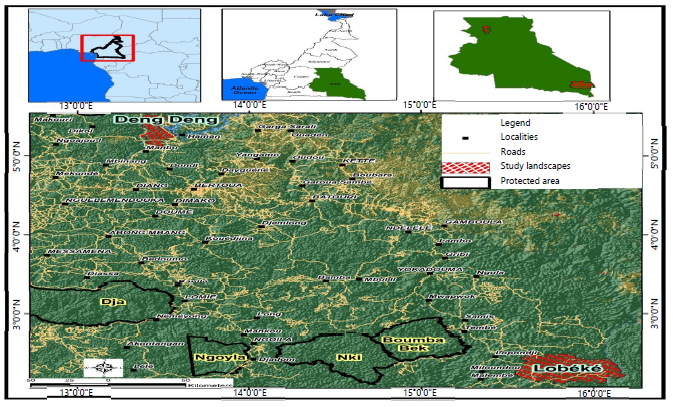
Study area and duration: The study was conducted in two protected areas in Cameroon’s East Region: Deng-Deng National Park and Lobéké National Park.The Deng-Deng National Park (5°30'-6°30' N, 13°00'-14°30' E) spans approximately 68,264 hectares across parts of the Mbam-and-Kim and Lom-and-Djérem divisions. Situated primarily along the Sanaga River, its eastern border adjoins the Lom Pangar Reservoir, while the northwest meets Mbam and Djerem National Park. The park lies within a forest-savanna transition zone, with vegetation predominantly semi-deciduous and evergreen forests. It experiences a humid tropical climate, with average annual rainfall between 1,400 and 1,600 mm and the mean temperatures from 22 to 28°C. Recognized as a biodiversity hotspot, Deng-Deng supports a wide range of wildlife, including two critically endangered great apes (Gorilla gorilla gorilla and Pan troglodytes ellioti), along with various endemic species of monkeys, birds, amphibians, reptiles, fungi, and plants. Local communities surrounding the park primarily engage in farming, hunting, and harvesting forest resources22.
The Lobéké National Park (2°00'-2°30'N, 15°30'-16°10'E) covers 217,854 hectares within the Boumba-and-Ngoko division. It forms part of the Sangha Tri-National (TNS) transboundary conservation area, which extends into the Republic of Congo and the Central African Republic. The park’s vegetation is dominated by lowland evergreen rainforest and swamp forest. Its humid tropical climate features average annual rainfall between 1,500 and 1,700 mm, mean temperatures from 20 to 30°C, and altitudes ranging from 300 to 750 m. Lobéké National Park is also a biodiversity hotspot, supporting a diverse array of wildlife, including two critically endangered great apes (Gorilla gorilla gorilla and Pan troglodytes ellioti), as well as numerous endemic species of monkeys, birds, amphibians, reptiles, fungi, and plants. The surrounding area is inhabited by Bantu agriculturalists and indigenous Baka people, whose livelihoods depend on hunting, farming, forest resource collection, and fishing23.
The survey was conducted between October 2025 and January 2026.
Data collection: Data on local knowledge, community perceptions, and economic reliance on great apes were collected through household surveys and over 50 focus group discussions (FGDs). Household surveys involved semi-structured, closed-ended, and open-ended recall questions. Data were recorded using KoboCollect Version 2025.2.3 and FGDs24. Most surveyed villages were located near or adjacent to the Deng-Deng and Lobéké National Parks in Cameroon's East Region (Fig. 1).
|
Due to the absence of official government demographic data, household numbers were provided by the village chief. In villages with fewer than 25 households, a door-to-door survey was conducted, utilizing semi-structured, closed-ended, and open-ended recall questions. After collecting demographic information (including sex, age, income level, education, occupation, marital status, and household size), respondents were asked about their knowledge of great apes and their views on their conservation.
Individual interviews were conducted, with the participants selected randomly regardless of their education or occupation. In villages with more than 25 households, Focus Group Discussions (FGDs) were organized. Each FGD comprised up to 10 participants, including volunteers and randomly selected villagers aged 18 or older, in compliance with Cameroonian law. National Identity Cards were verified for all participants; those without one required a recommendation from the local village chief or representative. Local field assistants translated questions into Baka dialects for participants with limited French proficiency. We interviewed at least 70% of households in each village, totaling 132 household interviews across 12 nearby villages. To aid understanding during interviews, participants were shown laminated photographs of the two species and their forest habitats25.
Data analysis: The collected socioeconomic data were analyzed through the Statistical Package for Social Sciences (SPSS) software. A Pearson Chi-square (χ2) analysis was also performed to determine the relationship and statistical significance between local knowledge, community perception, and great ape conservation across the different villages. The p-value ≤ 0.05 represented statistical significance at the 95% confidence interval.
RESULTS AND DISCUSSION
Socioeconomic characteristics of respondents: Among the respondents, 50.9% were male and 40.2% were female, majority (66.7%) was married (66.7%). A significant proportion of the respondents (29.5%) had lived in the area for 1-5 years, while (28.8%) had lived in the area for over 20 years. In terms of age distribution within households, 31.1% were aged 35-40 years, and about educational achievement, only 23.5% had a secondary education (Table 1). In terms of income, household annual earnings were measured in the local currency, the Franc CFA, with an exchange rate of 1 US$ to 553 FCFA, the February 2026 exchange rate. About 49.2% of the households had a very low income and were below the poverty line, which is defined by the World Bank as 3USD or (1659FCFA) per day26.
| Table 1: | Socioeconomic characteristics of the respondents across the study sites | |||
| Socioeconomic Characteristics | Number of respondents | Total (%) of respondents |
| Household status | ||
| Head of household | 80 | 60.6 |
| Household member | 23 | 17.4 |
| Spouses | 29 | 22 |
| Gender | ||
| Female | 53 | 40.2 |
| Male | 79 | 59.8 |
| Marital status | ||
| Divorced | 1 | 0.8 |
| Married | 88 | 66.7 |
| Single | 34 | 25.8 |
| Widowed | 9 | 6.8 |
| Age of respondents | ||
| 20-24 | 4 | 3 |
| 25-29 | 22 | 16.7 |
| 30-34 | 18 | 13.6 |
| 35-40 | 41 | 31.1 |
| 41-45 | 23 | 17.4 |
| 46-above | 20 | 15.2 |
| Educational level | ||
| No formal education | 22 | 16.7 |
| Primary education | 79 | 59.8 |
| Secondary education | 31 | 23.5 |
| University education | 0 | 0 |
| Religion | ||
| Christianity | 120 | 90.9 |
| Islam | 3 | 2.3 |
| Animists | 9 | 6.8 |
| Household size | ||
| 1-3 persons | 70 | 53 |
| 4-6 persons | 41 | 31.1 |
| 7-9 persons | 10 | 7.6 |
| Above 10 | 11 | 8.3 |
| Main livelihood activity | ||
| Agriculture | 110 | 83.3 |
| Crafts | 1 | 0.8 |
| Commerce | 9 | 6.8 |
| Forestry | 7 | 5.3 |
| Hunting | 3 | 2.3 |
| Others | 2 | 1.5 |
| Annual Income | ||
| 0-100000FCFA | 65 | 49.2 |
| 101000-200000FCFA | 8 | 21.2 |
| 201000-300000FCFA | 26 | 19.7 |
| 301000-400000FCFA | 7 | 5.3 |
| Above 401000FCFA | 6 | 4.5 |
| Years of residence | ||
| Less than 1 year | 19 | 14.4 |
| 1-5 years | 39 | 29.5 |
| 6-10 years | 13 | 9.8 |
| 11-20 years | 23 | 17.4 |
| Above 20 years | 38 | 28.8 |
| Table 2: | Participant's response to the reaction during encounter with great ape in relation to age | |||
| Chi-square tests | Value | df | Asymptotic significance (2-sided) |
| Pearson Chi-square | 17.064 | 8 | 0.029 |
| Likelihood ratio | 17.967 | 8 | 0.021 |
| N of valid cases | 132 |
| Table 3: | Participants' ability to perceive change in the frequency of great apes in relation to household status | |||
| Chi-square tests | Value | df | Asymptotic significance (2-sided) |
| Pearson Chi-square | 31.699 | 8 | 0 |
| Likelihood ratio | 37.852 | 8 | 0 |
| N of valid cases | 132 |
| Table 4: | Participant response to the ability to discuss conservation with children in relation to household status | |||
| Chi-square tests | Value | df | Asymptotic significance (2-sided) |
| Pearson Chi-square | 25.86 | 8 | 0.001 |
| Likelihood ratio | 31.159 | 8 | 0 |
| N of valid cases | 132 |
| Table 5: | Participant response to the ability to discuss conservation with children in relation to the main livelihood activity | |||
| Chi-square tests | Value | df | Asymptotic significance (2-sided) |
| Pearson Chi-square | 50.945 | 20 | 0 |
| Likelihood ratio | 32.284 | 20 | 0.04 |
| N of valid cases | 132 |
| Table 6: | Respondent ability to express happiness in living with great apes in relation to main livelihood activity | |||
| Chi-square tests | Value | df | Asymptotic significance (2-sided) |
| Pearson Chi-square | 43.202 | 20 | 0.002 |
| Likelihood ratio | 26.939 | 20 | 0.137 |
| N of valid cases | 132 |
| Table 7: | Respondent ability to identify main threats to great apes in relation to main livelihood activity | |||
| Chi-square tests | Value | df | Asymptotic significance (2-sided) |
| Pearson Chi-square | 199.303 | 90 | 0 |
| Likelihood ratio | 51.717 | 90 | 1 |
| N of valid cases | 132 |
Local knowledge on the existence of great apes: Almost all respondents (99.2%) confirmed that great apes still occur in nearby forests, and an equal proportion was aware of their endangered status. Direct experience with great apes was also common, with 96.2% reporting having observed them alive within their locality.
Chi-square analysis showed that age of respondents significantly influenced reactions during encounters with great apes (χ2 = 17.064, p = 0.029) (Table 2).
Similarly, household status had a significant influence on perceived changes in the frequency of great apes (χ2 = 31.699, p<0.001) (Table 3), and the ability to discuss conservation issues with children (χ2 = 25.860, p = 0.001) (Table 4). Furthermore, the main livelihood activity significantly influenced respondents’ ability to discuss conservation with children (χ2 = 50.945, p<0.001) (Table 5).
Local perception and attitude towards great apes: Overall, 39.4% of respondents reported being very happy to have great apes in their village, and 91.7% expressed positive sentiments toward coexisting with them. During encounters, 46.2% indicated they would remain calm, whereas 25.0% reported that they would chase the animals away. A majority (70.5%) identified great apes as cultural or spiritual symbols, and 85% strongly agreed that wildlife, including great apes, should be conserved.
Pearson’s Chi-square analysis revealed that the main livelihood activity significantly influenced happiness in living with great apes (χ2 = 43.202, p = 0.002) (Table 6), and the ability to identify main threats to great apes (χ2= 199.303, p<0.001) (Table 7).
| Table 8: | Respondent ability to recognize human-great ape conflict in relation to household status | |||
| Chi-square tests | Value | df | Asymptotic significance (2-sided) |
| Pearson Chi-square | 14.348 | 2 | 0.001 |
| Likelihood ratio | 15.741 | 2 | 0 |
| N of valid cases | 132 |
| Table 9: | Respondent ability to recognize location of human-great ape conflict in relation to household status | |||
| Chi-square tests | Value | df | Asymptotic significance (2-sided) |
| Pearson Chi-square | 15.17 | 4 | 0.004 |
| Likelihood ratio | 16.517 | 4 | 0.002 |
| N of valid cases | 132 |
| Table 10: | Respondent ability to recognize nature of human-great ape conflict in relation to household status | |||
| Chi-square tests | Value | df | Asymptotic significance (2-sided) |
| Pearson Chi-square | 18.293 | 6 | 0.006 |
| Likelihood ratio | 19.575 | 6 | 0.003 |
| N of valid cases | 132 |
| Table 11: | Household dependence on great ape meat in relation to household status | |||
| Chi-square tests | Value | df | Asymptotic significance (2-sided) |
| Pearson Chi-square | 23.688 | 8 | 0.003 |
| Likelihood ratio | 28.445 | 8 | 0 |
| N of valid cases | 132 |
| Table 12: | Household ability to have a great ape hunter in relation to household status | |||
| Chi-square tests | Value | df | Asymptotic significance (2-sided) |
| Pearson Chi-square | 25.75 | 2 | 0 |
| Likelihood ratio | 27.744 | 2 | 0 |
| N of valid cases | 132 |
| Table 13: | Household possibility of having a great ape hunter in relation to duration of stay in the village | |||
| Chi-square tests | Value | df | Asymptotic significance (2-sided) |
| Pearson Chi-square | 20.408 | 4 | 0 |
| Likelihood ratio | 21.441 | 4 | 0 |
| N of valid cases | 132 |
Pressure on great apes and their habitats: Half of the respondents (50%) identified a combination of deforestation and poaching as the primary threats to great apes. Here, human-great ape conflict was reported by 69.7% of respondents, mainly involving crop destruction (47.0%). More than half (57.6%) admitted involvement in great ape hunting, while 67.4% acknowledged dependence on bushmeat and forest resources for their livelihoods.
Chi-square analysis indicated that household status significantly influenced the:
| • | Ability to recognize human-great ape conflict (χ2= 14.348, p = 0.001) (Table 8) | |
| • | Location of conflict (χ2 = 15.170, p = 0.004) (Table 9) | |
| • | Nature of conflict (χ2 = 18.293, p = 0.006) (Table 10) | |
| • | Dependence on bushmeat (χ2 = 23.688, p = 0.003) (Table 11) | |
| • | Likelihood of having a great ape hunter within the household (χ2 = 25.750, p<0.001) (Table 12) |
Similarly, duration of stay in the village significantly influenced the likelihood of a household having a great ape hunter (χ2 = 20.408, p<0.001) (Table 13).
These data offer important insights into great ape conservation, local perceptions, and the significance of traditional knowledge within Deng-Deng and Lobeké National Parks. Most respondents were male (59.8%) and married (66.7%), suggesting that a family-centric structure is often led by men. Given men’s greater involvement in farming, hunting, and forest-related work, their attitudes and practices significantly influence great ape conservation outcomes. However, women also constitute a significant percentage (40.2%) and contribute substantially to local ecological knowledge concerning forest resources.
Most respondents were aged 30-45, implying a high level of engagement in hunting and close interaction with forest ecosystems. This age group possesses practical knowledge of wildlife distribution, habitat shifts, and annual cycles, which could be invaluable for community-based conservation. Nevertheless, the low educational attainment among community members (most did not attend beyond primary school, and none attended university) may reduce awareness of conservation laws and global biodiversity significance. This highlights the need for specialized environmental education programs.
Agriculture is the primary source of income (83.3%), with almost half of the respondents generating less than 100,000 FCFA (180 USD) per year. This significant reliance on low-income agricultural livelihoods increases strain on forest resources through farm enlargement, habitat intrusion, and potential bushmeat hunting. If conservation initiatives limit resource access without offering alternative benefits, poverty can foster negative perceptions of protected areas, as noted earlier27. Significantly, numerous participants are long-term inhabitants, demonstrating well-established local ecological understanding.
The results illustrate remarkably high levels of local knowledge concerning the existence and conservation status of great apes. This extensive local knowledge indicates that community members are not passive observers but engaged witnesses to the ecological realities of their surroundings. This level of familiarity likely influences both their perceptions of and behavioral responses to great apes. The notable link between age and responses suggests generational variations in how people react to wildlife encounters. Elder respondents might rely on extensive experience and traditional ecological wisdom, potentially displaying increased calmness or responses shaped by culture. Conversely, younger individuals might react differently due to changing socio-economic factors, less exposure to traditional norms, or increased worries about safety and crop damage.
Moreover, household status notably affected views on great ape population trends, indicating that one’s social position within the community influences ecological awareness. In contrast to households relying on secondhand information or community stories, those more involved in farming or forest-related livelihoods typically experience more regular interaction with wildlife, leading to enhanced perceptions of population trends. These differences emphasize that instead of being consistent, ecological perception is shaped by social factors.
Household status notably impacted the capacity to engage children in conservation discussions, highlighting the household's importance in the intergenerational transfer of knowledge. Families with elevated social status, advanced education, or increased involvement in conservation efforts may feel more assured in discussing wildlife protection with younger generations. Conversely, families experiencing financial difficulties or prioritizing urgent survival issues might be less inclined to engage in conservation discussions.
Similarly, the impact of primary livelihood activities on the capacity to discuss conservation with children further highlights the critical role of economic context. Livelihood activities influence not only interaction with great apes but also how conservation narratives are shaped within the home. For instance, people whose lives are negatively affected by crop raiding may express more mixed or conflict-focused messages, while those benefiting from conservation initiatives or alternative income streams may share more optimistic perspectives.
Attitudinal results reinforce this view of significant awareness alongside complex lived experiences, indicating substantial normative support for conservation, even if enthusiasm is tempered by practical obstacles. The observation that 46.2% would stay composed during encounters, in contrast to 25.0% who would drive the animals away, indicates a balance between tolerance and protective instincts. Cultural dimensions also seem especially important, as traditional belief systems can offer a moral basis for coexistence.
Primary livelihood activities significantly impact happiness in communities coexisting with great apes, suggesting that economic factors influence both emotional well-being and cognitive understanding. Individuals more directly affected by habitat alteration or resource exploitation may have a clearer understanding of dangers like deforestation and poaching, but they also endure heightened stress related to conflict. Studies13,23,25,28 have emphasized the importance of integrating local ecological knowledge into conservation planning frameworks.
Overall, the findings underscore a complex interaction where strong cultural and social support for conservation coexists with livelihood-related vulnerabilities that influence attitudes and experiences. Despite documented instances of human-great ape conflict and hunting, the results show broadly positive community perceptions of great apes. This indicates that while enthusiasm may vary, there is solid social backing for coexisting with great apes. Additionally, observed behavioral intentions indicate relatively tolerant attitudes, suggesting that prolonged exposure to wildlife may foster familiarity and decrease fear. Nonetheless, the fact that 25% would actively drive away monkeys highlights ongoing concerns, likely related to crop destruction and economic instability. These varied reactions demonstrate the simultaneous presence of cultural appreciation and practical economic concern. Likewise, cultural values appear to significantly influence perceptions, with the link between cultural identity and conservation principles suggesting that traditional belief systems can strengthen pro-conservation attitudes.
Chi-square analyses indicate that attitudes and knowledge are not uniformly distributed across the community but are shaped by economic roles and daily interactions with the environment. As a result, farming households may experience more frequent crop raiding, leading to reduced happiness levels even as they acknowledge the importance of conservation. In contrast, those engaged in non-agricultural livelihoods or conservation efforts may exhibit increased tolerance and a heightened awareness of environmental issues such as deforestation and poaching. The significant impact of livelihood activities on reported conflicts and interactions further reinforces that economic involvement with the environment shapes human-great ape dynamics. Similarly, studies in the Menchum landscape region of northwest Cameroon and Tofalla Hill Wildlife Sanctuary in southwest Cameroon12,29, respectively found that local knowledge and experience significantly influenced environmental awareness.
The results demonstrate a complex connection between local livelihoods and great ape conservation, suggesting it is intrinsically linked to concerns about livelihood stability, family dynamics, and community cohesion. For example, while half of the participants recognized deforestation and poaching as the main dangers to great apes, a significant number also admitted to being directly or indirectly involved in actions that exacerbate those threats. This evident contradiction underscores the conflict between conservation awareness and livelihood reliance.
The significant number of respondents reporting human-great ape conflict, especially regarding crop damage, implies that such conflict is a persistent and widespread issue rather than an isolated incident. Crop raiding likely represents an economic disadvantage and a mental strain for families, possibly strengthening unfavorable views of great apes. Such experiences can lower tolerance levels and heighten the chances of retaliatory behavior, such as hunting.
Over half of the respondents acknowledged their participation in great ape hunting and reliance on bushmeat and forest resources, highlighting the importance of forest-based livelihoods near Deng Deng and Lobeke national parks. The consumption of bushmeat appears to be not merely opportunistic but also deeply integrated into household survival strategies. Similarly5,14,30, identified a link between economic circumstances and resource reliance. Their research indicated that low-income families relied more on bushmeat and other forest resources, contributing to ecological degradation.
Chi-square analyses reveal that household status significantly influences awareness of human-great ape conflict, including its existence, location, and attributes. This suggests that a community’s socioeconomic status dictates its exposure to or understanding of such conflicts. Consequently, households in certain socioeconomic conditions may engage more in agricultural or forestry practices, leading to increased interactions with great apes.
Similarly, household status significantly impacted reliance on bushmeat and the likelihood of a great ape hunter residing within the household. These results suggest that hunting habits are not evenly distributed throughout the population but are influenced by specific household conditions. Furthermore, the strong correlation between village tenure and the presence of a great ape hunter implies that long-term inhabitants may possess a deeper understanding of forest environments, hunting techniques, and animal behaviors. Conversely, extended stays might also enhance social connections that support hunting activities, as observed in Cameroon’s Rumpi Hills forests31.
SIGNIFICANCE STATEMENT
This study demonstrates how socioeconomic factors, livelihood strategies, and household characteristics influence conservation behaviors in communities surrounding great ape habitats. It reveals important links between human-wildlife conflict, length of residence, and household status in shaping conservation outcomes. Despite ongoing dependence on forest resources, local communities generally hold favorable attitudes toward gorillas and chimpanzees. The findings provide evidence-based recommendations, including community-led conservation, sustainable agroforestry, value-chain development, and alternative livelihoods. These insights are relevant for policymakers and stakeholders aiming to promote sustainable development, biodiversity conservation, and harmonious coexistence between humans and great apes.
CONCLUSION
This study demonstrates that conservation outcomes for great apes in the Deng-Deng and Lobéké National Parks are strongly shaped by socioeconomic conditions, livelihood dependence on forest resources, and household-level characteristics. While awareness of great apes and generally positive attitudes toward their conservation are widespread, these perceptions are constrained by persistent reliance on bushmeat, agricultural expansion, and ongoing human wildlife conflict.
The findings highlight a clear tension between conservation knowledge and livelihood realities, where economic vulnerability often drives behaviors that indirectly or directly threaten great ape populations. Household status, livelihood type, and duration of residence were shown to significantly influence perceptions, attitudes, and engagement in conservation-related behaviors.
Overall, effective great ape conservation in the region requires integrated strategies that combine community-based conservation approaches, alternative livelihood development, conflict mitigation, and targeted environmental education. Strengthening collaboration between local communities, conservation authorities, and policymakers is essential to achieving long-term coexistence between humans and great apes while ensuring sustainable rural development.
REFERENCES
- >Roopsind, A., B. Sohngen and J. Brandt, 2019. Evidence that a national REDD+ program reduces tree cover loss and carbon emissions in a high forest cover, low deforestation country. Proc. Natl. Acad. Sci. U.S.A., 116: 24492-24499.
- Ordaz‐Németh, I., T. Sop, B. Amarasekaran, M. Bachmann and C. Boesch et al., 2021. Range-wide indicators of African great ape density distribution. Am. J. Primatol., 83.
- Wright, J.H. and N.E.C. Priston, 2010. Hunting and trapping in Lebialem Division, Cameroon: Bushmeat harvesting practices and human reliance. Endanger. Species Res., 11: 1-12.
- Hicks, T.C., L. Darby, J. Hart, J. Swinkels, N. January and S. Menken, 2010. Trade in orphans and bushmeat threatens one of the Democratic Republic of the Congo’s most important populations of Eastern chimpanzees (Pan troglodytes schweinfurthii). Afr. Primates, 7: 1-18.
- Strindberg, S., F. Maisels, E.A. Williamson, S. Blake and E.J. Stokes et al., 2018. Guns, germs, and trees determine density and distribution of gorillas and chimpanzees in Western Equatorial Africa. Sci. Adv., 4.
- Carvalho, J.S., B. Graham, G. Bocksberger, F. Maisels and E.A. Williamson et al., 2021. Predicting range shifts of African apes under global change scenarios. Divers. Distrib., 27: 1663-1679.
- Junker, J., S. Blake, C. Boesch, G. Campbell and L. du Toit et al., 2012. Recent decline in suitable environmental conditions for African great apes. Divers. Distrib., 18: 1077-1091.
- Wessling, E.G., A. Whiten, S.K. Soiret, K. Scholfield and L. Samuni et al., 2025. Concerted conservation actions to support chimpanzee cultures. Phil. Trans. R. Soc. B, 380. https://doi.org/10.1098/rstb.2024.0143
- Jones, K.R., O. Venter, R.A. Fuller, J.R. Allan, S.L. Maxwell, P.J. Negret and J.E.M. Watson, 2018. One-third of global protected land is under intense human pressure. Science, 360: 788-791.
- Heinicke, S., R. Mundry, C. Boesch, B. Amarasekaran and A. Barrie et al., 2019. Advancing conservation planning for western chimpanzees using IUCN SSC A.P.E.S.—the case of a taxon-specific database. Environ. Res. Lett., 14.
- Wade, A.H. and N. Malone, 2021. Ecological, historical, economic, and political factors shaping the human-gorilla interface in the Mone-Oku Forest, Cameroon. Diversity, 13.
- Chuo, M.D., T.E. Angwafo, F. Chefor and T. Awa II, 2021. Valorization of great apes wild materials in traditional medicine; threats to apes conservation in the Menchum Landscape Areas, NW Cameroon. Int. J. Primatol. Res., 4.
- Rich, A.M., M.D. Wasserman, K.D. Hunt and F.A. Kaestle, 2020. Chimpanzee (Pan troglodytes schweinfurthii) population spans multiple protected areas in the Albertine Rift. Folia Primatol., 91: 595-609.
- Hofner, A.N., C.A.J. Robinson and K.A.I. Nekaris, 2018. Preserving Preuss’s red colobus (Piliocolobus preussi): An ethnographic analysis of hunting, conservation, and changing perceptions of primates in Ikenge-Bakoko, Cameroon. Int. J. Primatol., 39: 895-917.
- Fotang, C., U. Bröring, C. Roos, P. Dutton and L.R.D. Tédonzong et al., 2023. Mapping suitable habitat for Nigeria-Cameroon chimpanzees in Kom-Wum forest reserve, North-Western Cameroon. Primates, 64: 339-350.
- Kamgang, S.A., K.S. Bobo, F. Maisels, R.D.D. Ambahe and D.E.A. Ongono et al., 2018. The relationship between the abundance of the Nigeria-Cameroon chimpanzee (Pan troglodytes ellioti) and its habitat: A conservation concern in Mbam-Djerem National Park, Cameroon. BMC Ecol., 18.
- Bobo, K.S. and R.B. Weladji, 2011. Wildlife and land use conflicts in the Mbam and Djerem conservation Region, Cameroon: Status and mitigation measures. Hum. Dimens. Wildl., 16: 445-457.
- Kormos, R., C.F. Kormos, T. Humle, A. Lanjouw and H. Rainer et al., 2014. Great apes and biodiversity offset projects in Africa: The case for national offset strategies. PLoS ONE, 9.
- van Leeuwen, K.L., R.A. Hill and A.H. Korstjens, 2020. Classifying chimpanzee (Pan troglodytes) landscapes across large-scale environmental gradients in Africa. Int. J. Primatol., 41: 800-821.
- Mfossa, D.M., E. Gazagne, R.J. Gray, M.E. Ketchen and E.A. Abwe et al., 2023. Montane grassland resources drive gorilla (Gorilla gorilla) nesting behaviors in the Ebo forest, Littoral Region, Cameroon. Eur. J. Wildl. Res., 69.
- Mohamed-Djawad, M.H., N.M. Longo-Pendy, S.E. Dibakou, C. Puppo and J. Nzue-Nguema et al., 2025. Traditional ecological knowledge for great ape conservation in Gabon. J. Ethnobiol. Ethnomed., 21.
- Maurice, M.E., E.L. Ebong, N. Penda, M.C. Keafon, A.C. Awuanuge and O.F. Gildas, 2020. An assessment of anthropogenic activity on the pangolin population in Deng-Deng National Park, Eastern Region, Cameroon. Int. J. Adv. Res. Bot., 6: 15-24.
- Weiss, A., 2025. Personality structure in wild Eastern chimpanzees (Pan troglodytes schweinfurthii). J. Comp. Psychol., 139: 325-330.
- Beckline, M., S. Yujun, D. Etongo, S. Saeed and Abdul Mannan, 2018. Assessing the drivers of land use change in the Rumpi hills forest protected area, Cameroon. J. Sustainable For., 37: 592-618.
- Nkemnyi, M.F., T. de Herdt, G.B. Chuyong and T. Vanwing, 2016. The influence of institutions on access to forest resources in Cameroon: The case of Tofala Hill Wildlife Sanctuary. J. Nat. Conserv., 34: 42-50.
- Chen, S. and M. Ravallion, 2007. Absolute poverty measures for the developing world, 1981-2004. Proc. Natl. Acad. Sci. U.S.A., 104: 16757-16762.
- Beckline, M., Abdul Manan, N. Dominic, N. Mukete and Y. Hu, 2022. Patterns and challenges of forest resources conservation in Cameroon. Open Access Lib. J., 9.
- Fotsing, E.D.B., M.M.F. Kamkeng and D. Zinner, 2024. Opinions, attitudes and perceptions of local people towards the conservation of Nigeria‐Cameroon chimpanzees in Mpem-Djim National Park, Central Cameroon. People Nat., 6: 865-881.
- Nkemnyi, M.F., A. de Haas, N.D. Etiendem and F. Ndobegang, 2013. Making hard choices: Balancing indigenous communities livelihood and Cross River gorilla conservation in the Lebialem-Mone Fforest landscape, Cameroon. Environ. Dev. Sustainability, 15: 841-857.
- Angelsen, A., P. Jagger, R. Babigumira, B. Belcher and N.J. Hogarth et al., 2014. Environmental income and rural livelihoods: A global-comparative analysis. World Dev., 64: S12-S28.
- Mukete, B., Y. Sun, D. Etongo, R. Ekoungoulou, F. Folega, S. Sajjad, M. Ngoe and G. Ndiaye, 2018. Household characteristics and forest resources dependence in the Rumpi Hills of Cameroon. Appl. Ecol. Environ. Res., 16: 2755-2779.
How to Cite this paper?
APA-7 Style
Nkembi,
L., Mukete,
B., Nkemndem,
A., Vivian,
A., Ngoe,
M., Yang,
W., Sylvie,
F., Nkengafac,
N. (2026). Assessing the Human Dimensions of Great Ape Conservation through Socio-Economic Surveys in the Deng Deng and Lobeke National Parks of East Cameroon. Trends in Environmental Sciences, 2(3), 201-212. https://doi.org/10.21124/tes.2026.201.212
ACS Style
Nkembi,
L.; Mukete,
B.; Nkemndem,
A.; Vivian,
A.; Ngoe,
M.; Yang,
W.; Sylvie,
F.; Nkengafac,
N. Assessing the Human Dimensions of Great Ape Conservation through Socio-Economic Surveys in the Deng Deng and Lobeke National Parks of East Cameroon. Trends Env. Sci 2026, 2, 201-212. https://doi.org/10.21124/tes.2026.201.212
AMA Style
Nkembi
L, Mukete
B, Nkemndem
A, Vivian
A, Ngoe
M, Yang
W, Sylvie
F, Nkengafac
N. Assessing the Human Dimensions of Great Ape Conservation through Socio-Economic Surveys in the Deng Deng and Lobeke National Parks of East Cameroon. Trends in Environmental Sciences. 2026; 2(3): 201-212. https://doi.org/10.21124/tes.2026.201.212
Chicago/Turabian Style
Nkembi, Louis, Beckline Mukete, Agendia Nkemndem, Ajuah Vivian, Mukete Ngoe, Wang Yang, Fonkwo Sylvie, and Njunkeng Nkengafac.
2026. "Assessing the Human Dimensions of Great Ape Conservation through Socio-Economic Surveys in the Deng Deng and Lobeke National Parks of East Cameroon" Trends in Environmental Sciences 2, no. 3: 201-212. https://doi.org/10.21124/tes.2026.201.212

This work is licensed under a Creative Commons Attribution 4.0 International License.