
Phytoremediation and Growth Response of Common Duckweed (Lemna minor L.) to Copper and Chromium in Market Dumpsite Leachate: A Case Study from Maiduguri, Nigeria
-
Musa Adamu Ibrahim
Department of Biology, University of Maiduguri, P.M.B. 1069, Maiduguri, Nigeria
Muhammad Kabir Usman
Department of Biology, University of Maiduguri, P.M.B. 1069, Maiduguri, Nigeria
Yusha’u Usman MuhammadDepartment of Biology, University of Maiduguri, P.M.B. 1069, Maiduguri, Nigeria
Musa IbrahimDepartment of Biology, University of Maiduguri, P.M.B. 1069, Maiduguri, Nigeria
Ahmed AbbatorDepartment of Botany, University of Maiduguri, P.M.B. 1069, Maiduguri, Nigeria
Ibrahim Galadima DagonaNigeria Agricultural Quarantine Service, Northeast Zonal Office, Maiduguri, Nigeria
Mohammed Abdulhamid UmarDepartment of Botany, University of Maiduguri, P.M.B. 1069, Maiduguri, Nigeria
Mustapha SaiduDepartment of Biology, University of St Andrews, United Kingdom
| Received 05 Nov, 2025 |
Accepted 19 Jun, 2026 |
Published 30 Jun, 2026 |
Background and Objective: The prevalence of heavy metals in water poses a serious environmental challenge due to their toxicity, non-biodegradability, bioaccumulation, and carcinogenic potential, threatening both human health and aquatic ecosystems. This study aimed to evaluate the phytoremediation potential of the floating aquatic plant, duckweed (Lemna minor L.), for removing copper (Cu) and chromium (Cr) from dumpsite leachate. Materials and Methods: Lemna minor was exposed to varying concentrations of dumpsite leachate (0, 25, 50, 75, and 100% v/v) for 14 days. Physicochemical parameters of the leachate, including pH, electrical conductivity (EC), total dissolved solids (TDS), salinity, oxidation-reduction potential (ORP), and chemical oxygen demand (COD), were measured. Plant growth responses, including frond number, fresh weight, relative growth rate, and leaf pigmentation, were recorded. Statistical analyses were conducted to determine significant differences (p<0.05) across treatments. Results: At 50% v/v leachate, L. minor significantly reduced Cu by 42.2%, Cr by 25.3%, EC by 42.4%, TDS by 37.4%, salinity by 37.4%, ORP by 61.9%, and COD by 17.8%, while pH increased from 7.1 to 9.5. Higher leachate concentrations (100% v/v) caused significant decreases in frond number, biomass, relative growth rate, and pigmentation, indicating stress. Conclusion: Lemna minor can effectively tolerate and remediate up to 50% v/v of dumpsite leachate, highlighting its potential for phytoremediation of heavy-metal-contaminated waters. Further research is recommended to optimize environmental and ecophysiological conditions to enhance its remediation efficiency.
| Copyright © 2026 Ibrahim et al. This is an open-access article distributed under the Creative Commons Attribution License, which permits unrestricted use, distribution, and reproduction in any medium, provided the original work is properly cited. |
INTRODUCTION
Phytoremediation is a practical method for removing heavy metals from polluted environments1. This low-cost, ecologically safe technology uses plants to immobilize, absorb, reduce toxicity, stabilize, or degrade pollutants released into the environment from diverse anthropogenic sources2. Phytoremediation is considered safe and environmentally preferable when compared to physicochemical methods for remediating heavy-metal-contaminated sites3.
Common duckweed, Lemna minor L., is a floating aquatic macrophyte with a documented ability to remove pollutants from wastewater. Its uptake mechanism relies on passive diffusion via micropores in root cell walls, known as the apoplastic pathway, where sequestration or degradation of contaminants occurs4. Duckweeds (family Lemnaceae) are well suited to wastewater phytoremediation owing to their rapid vegetative reproduction, high nutrient uptake rates, tolerance to a wide range of growing conditions, and capacity to assimilate diverse contaminants5. Lemna minor has been reported as an effective phytoremediator for numerous pollutants6. Its global distribution7 and resilience to heavy metals, organic contaminants, and other environmental stressors support its applicability in the purification of agricultural, municipal, and industrial wastewater8. This species reduces the concentration of various aquatic pollutants, including heavy metals, nanomaterials, and organic compounds such as pharmaceuticals, hydrocarbons, toxins, and dyes9.
Heavy metal concentrations in drinking water have exceeded regulatory limits across multiple regions, partly driven by growth in industrial activity10. The accumulation of heavy-metal-contaminated sites has intensified with industrialization and urbanization, owing to emissions from electroplating, nonferrous metal smelting, mining tailings, and related processes11. Over ten million contaminated sites are estimated to exist worldwide, with heavy metal pollution contributing to over 50% of total site contamination12. The harmful effects of heavy metals such as arsenic, lead, nickel, cadmium, copper, and mercury in drinking water have drawn sustained attention from regulatory agencies and public health authorities10. Heavy metals are persistent, bio-accumulative, toxic, endocrine-disruptive, and carcinogenic13. Exposure to these metals is associated with skin disorders, respiratory disease, cancer, cardiovascular dysfunction, impaired excretory function, and growth retardation in humans14. The World Health Organization (WHO) estimates that exposure to environmental contaminants, particularly heavy metals, contributes to the deaths of more than 1.7 million children under the age of five annually15. Heavy metal contamination of aquatic environments constitutes a global public health concern due to the toxicity of these elements to aquatic organisms and their transfer to humans through the food chain16.
This study evaluated the phytoremediation potential of Lemna minor for the treatment of dumpsite leachate in Maiduguri, Nigeria, and assessed the growth responses of L. minor under varying leachate concentrations.
MATERIALS AND METHODS
Study area: Maiduguri, the capital of Borno State, North-East Nigeria, lies at 11°49’51.9528” N, 13°09 3.4812” E and has an elevation of 320 m above sea level. It is situated along the seasonal Ngadda River, which flows into the Firki swamps around Lake Chad. The climate of Maiduguri is classified as subtropical dry semi-arid steppe, with an average annual temperature of 34.78°C, which is higher than the national average of Nigeria. The average annual rainfall is 225 mm, which is very low and concentrated in the summer months from June to September. The city has a long dry season from October to May, with very hot and sunny days and cool nights. The main activities of the people are agriculture, livestock, fishing, trade and education.
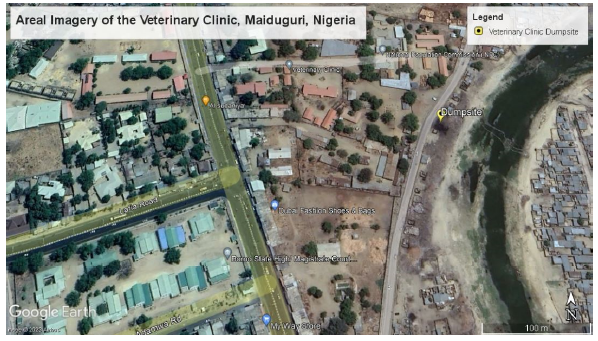
Collection of dumpsite soil: Composite dumpsite-soil samples (500 g) were collected in a polythene bag behind Ali Modu Shariff Veterinary Clinic (11°49’44.598” N and 13°9’23.226” E) (Fig. 1) on 7th August, 2023, at 9:20 a.m. and transferred to Laboratory for further experiment.
|
Preparation of dumpsite leachate: Collected solid wastes were sieved and transferred to a plastic container (5.0 L) and mixed with 2.5 L distilled water. It was then filtered through 0.7 μm Whatman filter paper. The 1.5 L filtrate was collected into 4 Erlenmeyer flask (800 mL), and then diluted to various concentrations of 100%, 75%, 50% and 25% and 0% (control).
Collection of duckweed: Duckweeds (Lemna minor) were collected and put into a plastic container from stagnant water (11°50’32.26” N, 13°10’07.84” E) in Gwange ward, Maiduguri, Nigeria. The samples were then transported to Laboratory for the experiment.
Sterilization and acclimatization: Lemna minor samples were carefully washed with tap water and rinsed with distilled water to remove unwanted pathogens, debris and other impurities. Then, sterilized by submerging the Duckweed in 0.5% (v/v) NaOCl for 30 sec, and rinsed with distilled water twice. The collected duckweed samples were acclimatized in clean dechlorinated water for 7 days.
Experimental design and set-up: A completely randomized design (CRD) with five replicates using plastic containers (170 mL) was arranged in an open environment. The treatments; Control 0, 25, 50, 75 and 100% of 100 mL leachates were added. Sterilized three 2-frond duckweeds were inoculated to each set of the treatment groups. Containers were covered with transparent polythene (cling film) to prevent evaporation and mould infestation. Small openings were made for gaseous exchange. Lost water due to evapotranspiration/evaporation was replaced daily with distilled water to maintain constant volume.
Determination of physicochemical parameters: Water parameters including pH, total dissolved solids (TDS), chemical oxygen demand (COD), electric conductivity (EC), salinity, oxidation reduction potential (ORP) and temperature (on site) were measured17.
Determination of heavy metals: Heavy metals were determined in test media using an Atomic Absorption Spectrophotometer (AAS) in different concentrations of the leachate (100, 75, 50 and 25%v/v)18.
Growth rate: The growth rate was determined by counting the number of fronds and measuring the fresh weight of Lemna minor using a weighing scale (G&G® JJ1000). Visual changes in duckweed were observed throughout the experimental period.
Determination of relative growth rate: The relative growth rate was calculated based on the increase in fresh weight after a 14-day experiment, using similar equation provided18:
| (1) |
where, Wi (g) and Wf (g) are initial and final weights of Lemna minor, respectively
Determination of pigmentation rate: Photosynthetic pigments were measured by UV-Spectrophotometer (MF-21D)18. Briefly, fresh duckweed (fronds and roots) was weighed (0.1 g) using a weighing scale (G&G® JJ1000) and ground with 100% acetone until the tissue was completely homogenized. The extract solution was centrifuged at room temperature for 3 minutes at 3000 rpm to obtain a clear supernatant. The supernatant was transferred to a cuvette and absorbance was measured at 661.6 nm, 644.8 nm and 470 nm. The following equations were applied to calculate the pigment concentrations in μg/mL of solution:
Chlorophyll a: Ca = 11.24 A661.6-2.04 A644.8 |
(2) |
Chlorophyll b: Cb = 20.13 A644.8-4.19 A661.6 |
(3) |
| (4) |
where, A = Absorbance (nm)
Statistical analysis: Paired t-test and descriptive statistics were conducted using GraphPad Prism® (ver. 8.0.2) for Windows (GraphPad Software, Boston, Massachusetts, USA) at p<0.05 significant level was used to determine if there was a significant difference at pre and post-remediation. While percentage removal was calculated using Microsoft Excel.
RESULTS
Physicochemical parameters analysis: The physicochemical parameters were measured before and after the introduction of L. minor in dumpsite leachate. It was observed that the plant significantly reduced the physicochemical parameters. The highest reduction in physicochemical parameters measured were at 50%v/v leachate in electric conductivity (EC) of 42.4%, total dissolved solids (TDS) and salinity were all 37.4%, oxidation-reduction potential (ORP), 61.9%, chemical oxygen demand (COD), 17.8%. However, there was a significant reduction in pH in all the concentrations of leachate, with 50% v/v being the highest reduction observed (Table 1).
Heavy metals removal in dumpsite lachate by Lemna minor: Table 2 shows the removal efficiency of heavy metals (Copper and Chromium) by the L. minor in dumpsite leachate. The maximum reduction efficiency (t = 120.9, p = 0.0001) was 42.1% and 25.3%, for Copper, and Chromium, respectively at 50% v/v.
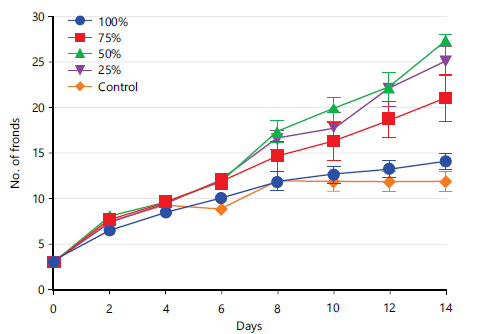
Effect of dumpsite leachate on number of fronds: The number of fronds counted every two days during a 14-day experiment. The number of fronds varied depending on the leachate concentration and duration of exposure. The highest number of fronds was observed in 50% v/v and 25% v/v of dumpsite leachate treatment. The lowest number of fronds was observed in the control treatment (Fig. 2).
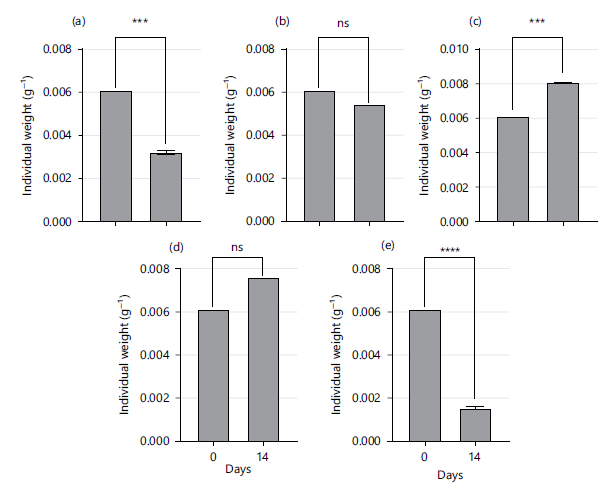
Fresh weight of Lemna minor in different concentrations: The results showed that at (p<0.05) the fresh weight increased in the 50% v/v (Fig. 3c) and 25% v/v (Fig. 3d) leachate treatments, which had mean values of 0.0081 g and 0.0076 g (fresh weight) per plant respectively, after exposure. These values were significantly higher than the initial fresh weight of 0.0061 g per plant. The fresh weight decreased in the 0% (Fig. 3e), 75% v/v (Fig. 3b) and 100% v/v (Fig. 3a) leachate treatments which had mean values of 0.0016, 0.0054 and 0.0032 g (fresh weight) per plant respectively, after exposure. These values were significantly lower than the initial fresh weight of 0.0061 g (fresh weight) per plant (Fig. 3a-e).
|
| Table 1: | Physico-chemical parameters (n = 3) of dumpsite leachate at different time of introduction of Lemna minor | |||
| Parameter | Conc. (%) | Before (time) | After (time) | t-value | p-value | Reduction (%) |
| EC (μS/cm) | 100 | 2549±1.0 | 1669±0.9 | 2641 | 0.0001 | 34.5 |
| 75 | 1860±0.0 | 1168±0.3 | 2075 | 0.0001 | 37.2 | |
| 50 | 1287±0.0 | 741±0.6 | 945.7 | 0.0001 | 42.4 | |
| 25 | 674±0.6 | 410.3±0.3 | 395.5 | 0.0001 | 39.1 | |
| 0 | 10.7±0.3 | 9.667±0.3 | - | ns | 9.4 | |
| TDS (mg/L) | 100 | 1270±5.8 | 991±4.4 | 182.6 | 0.0001 | 21.9 |
| 75 | 930±0.0 | 682.3±0.7 | 371.5 | 0.0001 | 26.6 | |
| 50 | 642.3±0.7 | 402±0.0 | 360.5 | 0.0001 | 37.4 | |
| 25 | 226.7±0.3 | 162±0.0 | 194 | 0.0001 | 28.5 | |
| 0 | 1.0±0.0 | 1.0±0.00 | - | ns | 0 | |
| Salinity (mg/L) | 100 | 1283±3.3 | 991.7±0.3 | 79.6 | 0.0002 | 22.7 |
| 75 | 920.0±0.0 | 682.3±0.7 | 356.5 | 0.0001 | 25.8 | |
| 50 | 642.0±0.6 | 402.0±0.0 | 415.7 | 0.0001 | 37.4 | |
| 25 | 337.3±0.3 | 244.7±0.3 | 278 | 0.0001 | 27.5 | |
| 0 | 2.0±0.0 | 2.0±0.0 | - | ns | 0 | |
| ORP (mv) | 100 | 427.3±1.2 | 243.3±1.2 | - | ns | 43.1 |
| 75 | 343.3±0.9 | 173.3±0.3 | 294.4 | 0.0001 | 49.5 | |
| 50 | 224.3±0.9 | 85.3±0.3 | 139 | 0.0001 | 61.9 | |
| 25 | 102.0±0.6 | 44.67±0.3 | 172 | 0.0001 | 56.2 | |
| 0 | 27.67±0.3 | 22.67±0.3 | - | ns | 18.1 | |
| Temp. ( ) | 100 | 29.4±0.0 | 28.33±0.3 | 4.556 | 0.045 | 5.34 |
| 75 | 29.6±0.1 | 28.63±0.0 | 10.9 | 0.0082 | 3.27 | |
| 50 | 29.8±0.1 | 28.7±0.1 | 5.8 | 0.029 | 3.58 | |
| 25 | 29.8±0.0 | 28.6±0.0 | 20.8 | 0.0023 | 4.02 | |
| 0 | 27.8±0.0 | 27.9±0.1 | 1.7 | 0.2254 | 0.72 | |
| COD (mg/L) | 100 | 49.2±0.1 | 44.2±0.0 | 82.1 | 0.0001 | 10.1 |
| 75 | 36.9±0.1 | 32.2±0.0 | 68.4 | 0.0002 | 12.9 | |
| 50 | 24.5±0.1 | 20.1±0.0 | 64.4 | 0.0002 | 17.8 | |
| 25 | 12.1±0.0 | 10.5±0.0 | 77.4 | 0.0002 | 14.7 | |
| 0 | 2.423±0.0 | 2.3±0.0 | - | ns | 3.3 | |
| *pH (-) | 100 | 7.1± 0.02 | 8.2±0.0 | 57.2 | 0.0003 | -16.9 |
| 75 | 7.2±0.0 | 8.5±0.0 | 63.9 | 0.0002 | -18.1 | |
| 50 | 7.1±0.0 | 9.5±0.0 | 72.9 | 0.0002 | -33.7 | |
| 25 | 7.1±0.0 | 9.4±0.0 | 114.8 | 0.0001 | -32.9 | |
| 0 | 2.423±0.0 | 2.3±0.0 | - | ns | 3.3 | |
| Values are expressed as Mean±Standard Deviation (n = 3). EC: Electrical Conductivity, TDS: Total Dissolved Solids, ORP: Oxidation-Reduction Potential. COD: Chemical Oxygen Demand, Temp.: Temperature, pH: Potential of hydrogen and ns: Non-significant. Statistical significance was determined using t-test, where p≤0.05 was considered significant. Percentage reduction (%) represents the change in parameter values after exposure of Lemna minor to dumpsite leachate. Negative values indicate an increase in the parameter after treatment. All units are reported as provided: EC (μS/cm), TDS (mg/L), Salinity (mg/L), ORP (mV), COD (mg/L) and Temperature (°C) | ||||||
|
|
Relative growth rate of L. minor: The relative growth rate of Lemna minor increased progressively at lower leachate concentrations, peaking at 50% concentration (approx. 0.14 mg/day). However, a significant decline was observed at higher concentrations, with negative growth rates at 75% and 100%, indicating that high levels of dumpsite leachate inhibit plant development and lead to biomass loss shown in Fig 4.
|
| Table 2: | Concentrations of chromium and copper in dumpsite leachate before and after introduction of Lemna minor | |||
| Time | ||||||
| Heavy metal (mg/L) | Conc. (%) | Before | After | t-value | p-value | Reduction (%) |
| Chromium (Cr) | 100 | 0.84±0.0 | 0.73±0.0 | 133 | 0.0001 | 13.9 |
| 75 | 0.63±0.0 | 0.52±0.0 | 122 | 0.0001 | 17.1 | |
| 50 | 0.42±0.0 | 0.32±0.0 | 120.9 | 0.0001 | 25.3 | |
| 25 | 0.21±0.0 | 0.17±0.0 | 67 | 0.0002 | 20.8 | |
| 0 | 0.03±0.0 | 0.03±0.0 | - | ns | 2.9 | |
| Copper (Cu) | 100 | 1.88±0.0 | 1.43±0.0 | 673 | 0.0001 | 23.9 |
| 75 | 1.41±0.0 | 1.02±0.0 | 383 | 0.0001 | 27.2 | |
| 50 | 0.94±0.0 | 0.54±0.0 | 685.9 | 0.0001 | 42.2 | |
| 25 | 0.47±0.0 | 0.30±0.0 | 261.5 | 0.0001 | 36.9 | |
| 0 | 0.09±0.0 | 0.08±0.0 | - | ns | 6.5 | |
| ns: Non significant and -: No value | ||||||
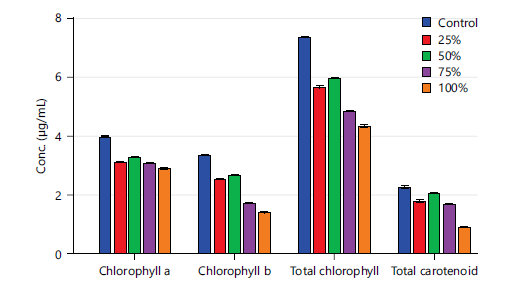
Effect of dumpsite leachate on pigmentation of L. minor: The chlorophyll content of L. minor was measured before and after exposure to different concentrations of dumpsite leachate. The results showed a decrease in all treatments compared to the control. The highest reduction in chlorophyll a, chlorophyll b, total chlorophyll and carotenoids was observed in 100% v/v leachate treatment which had a mean value of 2.91, 1.43, 4.34 and 0.91, respectively. The other treatments (25% v/v, 50% v/v and 75% v/v) also showed a significant decrease (p<0.05) in chlorophyll content but to a lesser extent than the 100% v/v treatment (Fig. 5).
DISCUSSION
Sustainable management of dumpsite leachate is a persistent environmental challenge in developing countries, including Nigeria. Lemna minor removes a broad range of pollutants from wastewater in an environmentally safe and cost-effective manner. The results of this study confirm that L. minor reduces physicochemical parameters in dumpsite leachate, particularly at moderate concentrations, supporting its suitability as a phytoremediation agent for this category of wastewater, which is typically rich in organic matter and dissolved nutrients.
The reductions in EC and TDS observed in this study indicate that L. minor absorbed dissolved salts and minerals from the leachate, improving its overall quality. These findings are consistent with work reported by Abdul Aziz et al.12, who demonstrated that Azolla pinnata and L. minor effectively reduce EC and TDS in diluted municipal wastewater, with L. minor outperforming A. pinnata in both parameters. The reductions in ORP and salinity imply that L. minor enhanced reducing conditions within the leachate, which
is favorable for the removal of certain metals and organic pollutants. These findings are consistent with results reported by Bhutiani et al.19, who observed reductions in salt concentration and ORP attributable to L. minor in industrial wastewater treatment. Such changes are indicative of improved redox conditions and decreased salinity, both of which are beneficial for aquatic systems.
The reduction of COD by L. minor indicates that the plant utilized a portion of the organic matter present in the leachate as a carbon source for growth and metabolism. These findings support those reported by Bhat et al.1, who observed COD reductions in the presence of L. minor, Salvinia minima, Ipomoea aquatica, and Centella asiatica. Substantial COD, BOD, TDS, and TKN removal from pulp and paper mill wastewater was also reported using Trapa natans L. and Eichhornia crassipes Solms20.
A notable outcome of this study was the shift in pH from approximately 7.1 to 9.5 at 50% v/v concentration, indicating a transition toward alkaline conditions. This alkaline shift is attributed to the release of alkaline metabolites, such as ammonia or bicarbonate, as a result of the plant's nitrogen metabolism or photosynthetic activity21,22. An alternative explanation is that L. minor removed acidic compounds such as nitrate or sulfate through active uptake or biochemical reduction, thereby reducing the overall acidity of the medium23. These observations contrast with earlier reports that described a decrease or no change in pH in the presence of L. minor across various wastewater types24. Lemna minor is known to tolerate a broad range of pH conditions, which contributes to its adaptability across diverse wastewater categories.
The maximum removal efficiency for copper (Cu) was observed at 50% v/v leachate concentration. This finding aligns with results reported by Daud et al.24, who documented effective Cu removal by L. minor from landfill leachate. The capacity of L. minor to absorb and accumulate Cu is attributed to its metal hyperaccumulation properties, making it a viable candidate for phytoremediation of Cu-contaminated water bodies. A comparable response was reported by Al-Baldawi et al.25, who observed significant Cu reduction in effluent treated with L. minor. It has additionally been documented that L. minor absorbs copper ions with greater speed and efficiency when exposed to a magnetic field compared to non-magnetized conditions.
A notable reduction in chromium (Cr) was also observed. These results are consistent with the findings of Sasmaz et al.26, who reported Cr removal by L. minor and Lemna gibba from waters associated with chromium mining operations. Sasmaz et al.26 further reported that both L. minor and L. gibba successfully removed chromium from mining drainage within eight days of exposure. According to Ubuza et al.4, duckweeds eliminate nickel and chromium from aqueous solutions even at low initial metal concentrations. Chaudhary and Sharma27 documented chromium and cadmium removal by L. gibba, identifying it as a hyperaccumulator for cadmium and a moderate accumulator for chromium based on bioconcentration factor analysis. In a separate study, duckweed removed up to 95% of lead and 84% of chromium from experimental solutions during a 12-day incubation period. Buta et al.28 demonstrated that, after one week of experimentation, Eichhornia crassipes, L. minor, and Pistia stratiotes each achieved high phytoremediation efficiency for chromium across two treatment facilities in Romania. Haokip and Gupta29 showed that Ipomoea aquatica extracts Cr and manganese from wastewater effectively, supporting the broader application of aquatic macrophytes in remediation of mixed-metal effluents.
The mechanisms underlying Cr removal by L. minor involve surface adsorption, precipitation, and direct plant uptake. Variation in the reduction efficiency for Cu and Cr among different leachate concentrations is attributable to differences in nutrient availability, the inherent toxicity of individual heavy metals, competition among metals for uptake sites, and the physiological adaptation of the plant to the prevailing stress conditions. Chidiac et al.30 suggested that lower concentrations of heavy metals stimulate the growth and metabolism of E. crassipes and L. gibba, whereas higher concentrations inhibit both processes through oxidative stress and damage to cellular structures.
The highest frond counts were recorded in the low-concentration leachate treatments, while the lowest were observed under high-concentration exposure. This pattern indicates that low to moderate leachate concentrations exert a stimulatory effect on L. minor growth, whereas high concentrations or prolonged exposure produce inhibitory or phytotoxic effects. Sackey et al.31 reported that diluted leachate stimulated frond production in L. minor, a finding consistent with the results of this study. This stimulatory effect at low concentrations is attributed to the presence of essential nutrients in diluted leachate that support plant growth without inducing toxicity. At higher concentrations, the accumulation of heavy metals and organic pollutants inhibits nutrient uptake and disrupts normal plant development26.
The increase in fresh weight at 25% and 50% v/v confirms that low-concentration leachate provides nutritional support without inducing phytotoxicity. The decrease in fresh weight observed at 0, 75, and 100% v/v is consistent with observations by Sasmaz et al.26, who identified an inverse relationship between leachate concentration and plant biomass, attributing this trend to the toxic effects of accumulated heavy metals and organic pollutants on nutrient absorption and plant development.
The significant reductions in chlorophyll a, chlorophyll b, total chlorophyll, and carotenoid content across all treatment groups are consistent with previous studies involving L. minor exposed to leachate and metal-contaminated effluents. Sackey et al.31 reported severe chlorophyll reductions at high leachate concentrations, attributable to the inhibitory effects of heavy metals and organic pollutants on chlorophyll biosynthesis and photosynthetic electron transport. The less severe but statistically significant pigment reductions recorded at 25% and 50% v/v indicate that physiological effects on pigment content persist even at lower concentrations, though their magnitude is substantially reduced compared to high-concentration exposure. These findings corroborate observations by Sasmaz et al.26, who documented chlorophyll decline in proportion to increasing leachate concentrations. The extent of pigment reduction is influenced by both the concentration and duration of contaminant exposure.
CONCLUSION
This study demonstrated that L. minor is a viable phytoremediation agent for dumpsite leachate, achieving significant reductions in physicochemical parameters and heavy metal concentrations over a 14-day exposure period. The plant performed best at 50% v/v leachate concentration, where the greatest reductions in EC, TDS, salinity, ORP, COD, copper, and chromium were recorded. Elevated leachate concentrations (75% and 100% v/v) inhibited frond production, biomass accumulation, and photosynthetic pigment synthesis, indicating dose-dependent phytotoxicity. The alkaline shift in pH observed across all leachate concentrations warrants further investigation into the underlying biochemical mechanisms.
These findings support the use of L. minor as an eco-friendly, low-cost option for treating dumpsite leachate in resource-limited settings such as Maiduguri. Further research is needed to determine the optimal environmental and eco-physiological conditions under which L. minor achieves maximum remediation efficiency. Future investigations should assess changes in microbial community composition, pollutant fate and bioaccumulation in plant tissues, and the broader ecosystem implications of duckweed-based treatment systems applied at scale. The risks and benefits of L. minor-based phytoremediation should be evaluated against conventional treatment alternatives. Collaboration among research institutions, local communities, and government agencies would be beneficial in scaling Lemna minor-based remediation approaches across Maiduguri and comparable settings within Nigeria.
SIGNIFICANCE STATEMENT
This study highlights the significance of Lemna minor as an effective, low-cost, and eco-friendly phytoremediation agent for treating copper- and chromium-contaminated dumpsite leachate. The plant significantly reduced physicochemical parameters and heavy metal concentrations, particularly at 50% v/v, demonstrating optimal remediation efficiency under moderate stress conditions. The findings support its application in sustainable wastewater treatment systems and provide important insights for improving nature-based solutions in managing industrial and municipal pollution in developing regions.
ACKNOWLEDGMENT
The authors acknowledged Mr. Philip Edward, Department of Biology, University of Maiduguri, Maiduguri, Nigeria for some technical assistance.
REFERENCES
- Bhat, S.A., O. Bashir, S. Anam Ul Haq, T. Amin and A. Rafiq et al., 2022. Phytoremediation of heavy metals in soil and water: An eco-friendly, sustainable and multidisciplinary approach. Chemosphere, 303.
- Kafle, A., A. Timilsina, A. Gautam, K. Adhikari, A. Bhattarai and N. Aryal, 2022. Phytoremediation: Mechanisms, plant selection and enhancement by natural and synthetic agents. Environ. Adv., 8.
- Aslanzadeh, M., A. Saboora and O. Moradlou, 2024. Phytoremediation potential of duckweed (Lemna minor L.) for hexavalent chromium removal in synthetic wastewater: Unveiling physiological response and defense mechanisms against excessive heavy metal uptake. Int. J. Environ. Sci. Technol., 21: 10155-10174.
- Ubuza, L.J.A., P.C.S. Padero, C.M.N. Nacalaban, J.T. Tolentino and D.C. Alcoran et al., 2020. Assessment of the potential of duckweed (Lemna minor L.) in treating lead-contaminated water through phytoremediation in stationary and recirculated set-ups. Environ. Eng. Res., 25: 977-982.
- Walsh, É., H. Kuehnhold, S. O’Brien, N.E. Coughlan and M.A.K. Jansen, 2021. Light intensity alters the phytoremediation potential of Lemna minor. Environ. Sci. Pollut. Res., 28: 16394-16407.
- Babu, S.M.O.F., M.B. Hossain, M. Safiur Rahman, Moshiur Rahman and A.S.S. Ahmed et al., 2021. Phytoremediation of toxic metals: A sustainable green solution for clean environment. Appl. Sci., 11.
- Zhou, Y., A. Stepanenko, O. Kishchenko, J. Xu and N. Borisjuk, 2023. Duckweeds for phytoremediation of polluted water. Plants, 12. https://doi.org/10.3390/plants12030589
- Yilmaz, D.D. and H. Akbulut, 2011. Effect of circulation on wastewater treatment by Lemna gibba and Lemna minor (floating aquatic macrophytes). Int. J. Phytorem., 13: 970-984.
- Aziz, K.H.H., F.S. Mustafa, K.M. Omer, S. Hama, R.F. Hamarawf and K.O. Rahman, 2023. Heavy metal pollution in the aquatic environment: Efficient and low-cost removal approaches to eliminate their toxicity: A review. RSC Adv., 13: 17595-17610.
- Song, P., D. Xu, J. Yue, Y. Ma, S. Dong and J. Feng, 2022. Recent advances in soil remediation technology for heavy metal contaminated sites: A critical review. Sci. Total Environ., 838.
- Su, R., Y. Wang, S. Huang, R. Chen and J. Wang, 2022. Application for ecological restoration of contaminated soil: Phytoremediation. Int. J. Environ. Res. Public Health, 19.
- Abdul Aziz, N.I.H., M.M. Hanafiah, N.H. Halim and P.A.S. Fidri, 2020. Phytoremediation of TSS, NH3-N and COD from sewage wastewater by Lemna minor L., Salvinia minima, Ipomea aquatica and Centella asiatica. Appl. Sci., 10.
- Parvin, F. and S.M. Tareq, 2021. Impact of landfill leachate contamination on surface and groundwater of Bangladesh: A systematic review and possible public health risks assessment. Appl. Water Sci., 11.
- Ansari, A.A., M. Naeem, S.S. Gill and F.M. AlZuaibr, 2020. Phytoremediation of contaminated waters: An eco-friendly technology based on aquatic macrophytes application. Egypt. J. Aquat. Res., 46: 371-376.
- Pushkar, B., P. Sevak, S. Parab and N. Nilkanth, 2021. Chromium pollution and its bioremediation mechanisms in bacteria: A review. J. Environ. Manage., 287.
- Karaouzas, I., N. Kapetanaki, A. Mentzafou, T.D. Kanellopoulos and N. Skoulikidis, 2021. Heavy metal contamination status in Greek surface waters: A review with application and evaluation of pollution indices. Chemosphere, 263.
- Akowanou, A.V.O., H.E.J. Deguenon, K.C. Balogoun, M.M.A. Daouda and M.P. Aina, 2023. The combined effect of three floating macrophytes in domestic wastewater treatment. Sci. Afr., 20.
- Fauzul Imron, M., S.B. Kurniawan and S.R.S. Abdullah, 2021. Resistance of bacteria isolated from leachate to heavy metals and the removal of Hg by Pseudomonas aeruginosa strain FZ-2 at different salinity levels in a batch biosorption system. Sustainable Environ. Res., 31.
- Bhutiani, R., N. Rai, N. Kumar, M. Rausa and F. Ahamad, 2019. Treatment of industrial waste water using water hyacinth (Eichornia crassipus) and duckweed (Lemna minor): A comparative study. Environ. Conserv. J., 20: 15-25.
- Kumar, V. and A.K. Chopra, 2018. Phytoremediation potential of water caltrop (Trapa natans L.) using municipal wastewater of the activated sludge process-based municipal wastewater treatment plant. Environ. Technol., 39: 12-23.
- Nika, M.C., K. Ntaiou, K. Elytis, V.S. Thomaidi and G. Gatidou et al., 2020. Wide-scope target analysis of emerging contaminants in landfill leachates and risk assessment using Risk Quotient methodology. J. Hazard. Mater., 394.
- Gamoń, F., M. Tomaszewski and A. Ziembińska-Buczyńska, 2019. Ecotoxicological study of landfill leachate treated in the ANAMMOX process. Water Qual. Res. J., 54: 230-241.
- Bożym, M., A. Król and K. Mizerna, 2021. Leachate and contact test with Lepidium sativum L. to assess the phytotoxicity of waste. Int. J. Environ. Sci. Technol., 18: 1975-1990.
- Daud, M.K., S. Ali, Z. Abbas, I.E. Zaheer and M.A. Riaz et al., 2018. Potential of duckweed (Lemna minor) for the phytoremediation of landfill leachate. J. Chem., 2018.
- Al-Baldawi, I.A., S.R. Yasin, S.S. Jasim, S.R.S. Abdullah, A.F. Almansoory and N.I. Ismail, 2022. Removal of copper by Azolla filiculoides and Lemna minor: Phytoremediation potential, adsorption kinetics and isotherms. Heliyon, 8.
- Sasmaz, A., I.M. Dogan and M. Sasmaz, 2016. Removal of Cr, Ni and Co in the water of chromium mining areas by using Lemna gibba L. and Lemna minor L. Water Environ. J., 30: 235-242.
- Chaudhary, E. and P. Sharma, 2019. Chromium and cadmium removal from wastewater using duckweed-Lemna gibba L. and ultrastructural deformation due to metal toxicity. Int. J. Phytorem., 21: 279-286.
- Buta, E., I.L. Borșan, M. Omotă, E.B. Trif and C.I. Bunea et al., 2023. Comparative phytoremediation potential of Eichhornia crassipes, Lemna minor, and Pistia stratiotes in two treatment facilities in Cluj County, Romania. Horticulturae, 9.
- Haokip, N. and A. Gupta, 2021. Phytoremediation of chromium and manganese by Ipomoea aquatica Forssk. from aqueous medium containing chromium-manganese mixtures in microcosms and mesocosms. Water Environ. J., 35: 884-891.
- Chidiac, S., P. El Najjar, N. Ouaini, Y. El Rayess and D. El Azzi, 2023. A comprehensive review of water quality indices (WQIs): History, models, attempts and perspectives. Rev. Environ. Sci. Biotechnol., 22: 349-395.
- Sackey, L.N.A., V. Kočí and C.A.M. van Gestel, 2020. Ecotoxicological effects on Lemna minor and Daphnia magna of leachates from differently aged landfills of Ghana. Sci. Total Environ., 698.
How to Cite this paper?
APA-7 Style
Ibrahim,
M.A., Usman,
M.K., Muhammad,
Y.U., Ibrahim,
M., Abbator,
A., Dagona,
I.G., Umar,
M.A., Saidu,
M. (2026). Phytoremediation and Growth Response of Common Duckweed (Lemna minor L.) to Copper and Chromium in Market Dumpsite Leachate: A Case Study from Maiduguri, Nigeria. Trends in Environmental Sciences, 2(2), 145-155. https://doi.org/10.21124/tes.2026.145.155
ACS Style
Ibrahim,
M.A.; Usman,
M.K.; Muhammad,
Y.U.; Ibrahim,
M.; Abbator,
A.; Dagona,
I.G.; Umar,
M.A.; Saidu,
M. Phytoremediation and Growth Response of Common Duckweed (Lemna minor L.) to Copper and Chromium in Market Dumpsite Leachate: A Case Study from Maiduguri, Nigeria. Trends Env. Sci 2026, 2, 145-155. https://doi.org/10.21124/tes.2026.145.155
AMA Style
Ibrahim
MA, Usman
MK, Muhammad
YU, Ibrahim
M, Abbator
A, Dagona
IG, Umar
MA, Saidu
M. Phytoremediation and Growth Response of Common Duckweed (Lemna minor L.) to Copper and Chromium in Market Dumpsite Leachate: A Case Study from Maiduguri, Nigeria. Trends in Environmental Sciences. 2026; 2(2): 145-155. https://doi.org/10.21124/tes.2026.145.155
Chicago/Turabian Style
Ibrahim, Musa, Adamu, Muhammad Kabir Usman, Yusha’u Usman Muhammad, Musa Ibrahim, Ahmed Abbator, Ibrahim Galadima Dagona, Mohammed Abdulhamid Umar, and Mustapha Saidu.
2026. "Phytoremediation and Growth Response of Common Duckweed (Lemna minor L.) to Copper and Chromium in Market Dumpsite Leachate: A Case Study from Maiduguri, Nigeria" Trends in Environmental Sciences 2, no. 2: 145-155. https://doi.org/10.21124/tes.2026.145.155

This work is licensed under a Creative Commons Attribution 4.0 International License.