
Impact of Community Health Volunteers in the Management of Buruli Ulcer in Imo State, South-Eastern Nigeria
-
Onwuka Chigozie Divine


Department of Applied and Environmental Biology, Imo State University, Owerri, PMB 2000, Nigeria
Oparaocha Evangeline TochiDepartment of Public Health, Federal University of Technology, Owerri, Nigeria
| Received 07 Jan, 2026 |
Accepted 16 Jul, 2026 |
Published 30 Sep, 2026 |
Background and Objective: Buruli ulcer (BU), caused by Mycobacterium ulcerans, remains a neglected tropical disease with devastating consequences in rural West Africa. Early detection and prompt treatment are critical for reducing morbidity, yet access to health facilities is often constrained. Community Health Volunteers (CHVs) have been deployed as a frontline strategy to enhance early case detection and referral, but evidence on their effectiveness in Nigeria remains limited. Materials and Methods: A retrospective review of 600 laboratory-confirmed BU cases reported between January 2018-December 2024 in Imo State was conducted. Data on mode of case detection (CHVs vs. self-referral) were extracted from state health records and analyzed using descriptive statistics. Qualitative insights were triangulated from interviews with CHVs and health officials to contextualize findings. Results: Of the 600 cases, 450 (75.0%) were detected through Community Health Volunteers, while 150 (25.0%) were self-referred. CHVs significantly enhanced early detection and timely referral, leading to higher treatment initiation rates. Qualitative data revealed that Community Health Volunteers facilitated trust-building, community awareness, and reduced delays in care-seeking, though challenges such as limited incentives, training gaps, and cultural beliefs persisted. Conclusion: Community Health Volunteers play a pivotal role in the detection and management of Buruli ulcer in Imo State, Nigeria. Their involvement not only strengthens surveillance and referral pathways but also bridges sociocultural barriers to care. Scaling up Community Health Volunteers programs with improved training, logistical support, and integration into national Neglected Tropical Diseases frameworks could accelerate BU control and align with global elimination targets.
| Copyright © 2026 Divine and Tochi. This is an open-access article distributed under the Creative Commons Attribution License, which permits unrestricted use, distribution, and reproduction in any medium, provided the original work is properly cited. |
INTRODUCTION
Buruli ulcer (BU), caused by Mycobacterium ulcerans, is a chronic necrotizing skin and soft tissue infection and the third most common mycobacterial infection after tuberculosis and leprosy1. The disease typically begins as painless nodules, plaques, or edema thatmay progress into extensive ulcers if treatment is delayed. Beyond its clinical effects, BU imposes substantial social and economic burdens, particularly in rural communities. Disability, stigma, loss of productivity, treatment costs further affect affected households2,3.
Globally, BU has been reported in over 30 countries, with West and Central Africa bearing over 80% of the burden1. Nigeriais considered endemic in the region, though the true prevalence remains uncertain due to under-reporting and limited surveillance systems. Sporadic reports from Imo, Ogun, and Anambra States suggest ongoing transmission4. Despite progress in control, early detection and access to treatment remain limited.
The World Health Organization recommends an eight-week antibiotic regimen of rifampicin and clarithromycin as the cornerstone of BU management. When initiated early, this regimen can prevent severe tissue damage and surgical intervention5. However; late presentation is still common in endemic regions, often driven by poor awareness, socio-cultural beliefs, poverty, stigma, and reliance on traditional healers6,7. these delays lead to advanced disease, prolonged treatment, and disability.
Community-based interventions are important for improving early detection and referral of neglected tropical diseases. In particular, Community Health Volunteers (CHVs) support community awareness, case identification, and referral. Evidence from Ghana and Côte d’Ivoire shows that CHVs improve early reporting and strengthen trust in biomedical treatment8,9.
Despite these benefits, evidence on community-based BU interventions in Nigeria remains limited, particularly in Imo State where transmission has been reported. Therefore, this study aimed to examine the role of community-based interventions in improving early detection and treatment of Buruli ulcer in endemic communities of Imo State, Nigeria.
MATERIALS AND METHODS
Study design: This study employed a mixed-methods design, integrating quantitative and qualitative approaches to assess the role of Community Health Volunteers (CHVs) in Buruli ulcer (BU) management in Imo State, Nigeria.
The quantitative component involved a retrospective review of BU health facility records (2018-2024) from three treatment centers, analyzing patient demographics, referral sources, lesion stage, treatment initiation, and outcomes.
The qualitative component used in-depth interviews with CHVs and health workers, focus Group Discussions with patients and caregivers, and key informant interviews with health officials to explore perceptions, challenges, and community experiences with CHVs in BU management.
Findings from both strands were integrated to provide a comprehensive understanding of CHV contributions to case detection, referral, treatment adherence, and community engagement.
Study area: This study was conducted in Imo State, South-Eastern Nigeria, which covers about 5,530 km2 with a population of 5.4 million people (NPC, 2022). Over 60% of inhabitants live in rural communities.
Imo State has a humid tropical climate with a long rainy season (April-October) and short dry season (November-March). Annual rainfall ranges from 2,000-2,500 mm and temperatures average 26-28°C. The state is traversed by rivers such as Otamiri, Nworie, Oramiriukwa, and Imo, with stagnant water bodies that favor Mycobacterium ulcerans transmission.
The people, predominantly Igbo, are engaged in subsistence farming, trading, and small-scale fishing. Many rural households rely on unprotected water sources, and poverty, poor sanitation, and limited access to safe water increase vulnerability to Buruli ulcer and other neglected tropical diseases.
Health services include three BU treatment and referral centers supported by the Ministry of Health and partners. However, access to care is constrained by distance, stigma, and preference for traditional remedies. To bridge gaps in detection and referral, Community Health Volunteers (CHVs) are integrated into the primary health care system.
Imo State remains BU-endemic, making it a suitable setting to evaluate the impact of CHVs on case detection, treatment adherence, and community health education.
Study population: The study population included:
| • | BU patients: All patients recorded at BU treatment centers were between January 2018 - December 2024 | |
| • | Community health volunteers (CHVs): Volunteers integrated into the primary healthcare system that was directly involved in BU case identification and referral | |
| • | Healthcare workers and officials: Staff at treatment centers and state health officials engaged in BU control activities | |
| • | Community members and caregivers: Individuals from BU-endemic communities providing experiential perspectives on the role of CHVs |
Sampling strategy
Quantitative: All Buruli ulcer (BU) cases recorded between January 2018-December 2024 were included in the analysis. Records with incomplete information on referral source or treatment outcomes were excluded.
Qualitative: Purposive sampling was used to recruit CHVs with at least one year of service, healthcare workers directly involved in BU management, and patients or caregivers representing different stages of the care pathway. Focus Group Discussions (FGDs) were stratified by gender and referral source (CHV referral vs. self-referral) to capture diverse perspectives.
Data collection
Quantitative data: Data were extracted using a structured checklist from BU patient registers and case management forms. Variables included: Patient demographics (age, sex, residence), Referral source (CHV, self-referral, or other), Stage of lesion at detection (early vs. advanced), Time from onset of symptoms to presentation, and Treatment initiation and completion status.
Qualitative data:
| • | In-depth interviews (IDIs): Conducted with CHVs and health workers to explore experiences in case finding, referral, and community engagement | |
| • | FGDs: Conducted with BU patients and caregivers to understand community knowledge, stigma, and perceptions of CHVs | |
| • | KIIs: Held with state and local health officials to capture policy and programmatic perspectives |
All interviews and FGDs were conducted in English or Igbo, audio-recorded with consent, and later transcribed verbatim.
Data collection tools: Data were gathered using structured extraction forms for facility records, pre-tested semi-structured interview guides for IDIs, FGDs, and KIIs, and field notes for contextual observations.
Data analysis
Quantitative analysis: Data were entered into SPSS version 26. Descriptive statistics (frequencies, proportions, and means) were used to summarize patient characteristics. Chi-square tests were applied to compare early versus late detection and treatment outcomes between CHV referrals and self-referrals. The level of significance was set at α = 0.05, and p-values less than 0.05 were considered statistically significant.
Qualitative analysis: Interview transcripts were imported into NVivo 12 for thematic analysis. The process involved data familiarization, open coding, and theme development focusing on CHVs’ roles, challenges, and community perceptions. Findings were triangulated with quantitative results to ensure a comprehensive interpretation.
Ethical considerations: Ethical approval was obtained from the Imo State University Research Ethics Committee (Ref No: IMSU/REC/BU/2023/07). Administrative permission was also obtained from the State Ministry of Health and the management of participating health facilities.
Informed consent was obtained from all qualitative participants, with additional parental consent for participants under 18 years. Confidentiality was ensured through anonymization of transcripts and secure data storage. Participation was voluntary, and respondents could withdraw at any time without consequence.
RESULTS
Quantitative findings
Mode of case detection of Buruli ulcer patients in Imo State (January 2018-December 2024): Out of the 600 confirmed BU cases recorded between January 2018 and December 2024, Community Health Volunteers (CHVs) were responsible for detecting 450 cases (75%), while only 150 cases (25%) resulted from self-referral, as illustrated in Table 1. This striking disparity highlights the critical role of CHVs as the primary drivers of case detection in Imo State.
The data suggest that without CHVs, a significant proportion of BU cases would likely remain undetected or present late, reinforcing evidence from other endemic countries where CHVs have been shown to enhance early diagnosis and linkage to care. Their effectiveness stems from their embeddedness within the community, which enables them to overcome barriers such as stigma, misinformation, and limited health-seeking behavior.
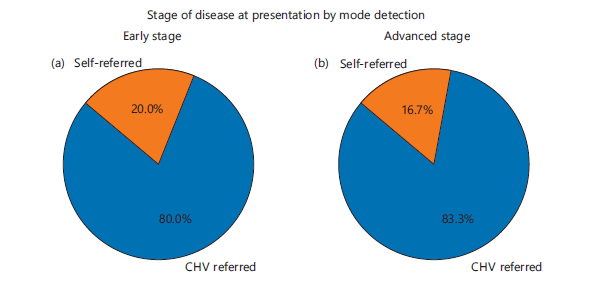
Early-stage detection: Analysis of stage at presentation showed no statistically significant association between referral pathway and clinical stage of Buruli ulcer as shown in Fig. 1. Although a greater proportion of early-stage cases were detected through community health volunteer (CHV) referral (62.4%) compared to self-referral (37.6%), and advanced-stage cases followed a similar distribution (83.3% vs. 16.7%), the difference was not significant (χ2 = 2.23, df = 1, p = 0.135. This suggests that both CHV referral and self-referral pathways contributed comparably to case detection across stages.
| Table 1: | Mode of case detection of Buruli ulcer patients in Imo State (January 2018-December 2024) | |||
| Mode of detection | Number of cases (n) | Percentage |
| Community Health Volunteers (CHVs) | 450 | 75 |
| Self-referral | 150 | 25 |
| Total | 600 | 100 |
|
| Table 1: | Treatment completion rates by mode of detection | |||
| Mode of Detection | Completed treatment (n, %) | Defaulted (n, %) |
| CHV Referred (n = 450) | 390 (86.7) | 60 (13.3) |
| Self-referred (n = 150) | 104 (69.3) | 46 (30.7) |
| Table 3: | Impact of CHVs on BU case management (n = 600) | |||
| Outcome indicator | CHV contribution (n, %) |
| Proportion of total cases detected | 450 (75.0) |
| Proportion of early-stage cases detected | 180 (30.0) |
| Treatment completion rate | 338 (75.0) |
| Reduction in default rate | 113 (25.0) |
Treatment completion rates by mode of detection: Treatment completion was notably higher among patients detected by community health volunteers (CHVs) than among those who self-referred. Overall, 86.7% of CHV-referred patients completed treatment, with only 13.3% defaulting, as shown in Table 2. In contrast, treatment completion among self-referred patients was lower at 69.3%, while 30.7% defaulted, as shown in Table 2. This indicates that CHV referral was strongly associated with improved adherence to treatment, highlighting the effectiveness of community-based detection in sustaining patient engagement throughout the treatment course.
Impact of community health volunteers on BU case management: Table 3 demonstrates the substantial contribution of Community Health Volunteers (CHVs) to Buruli ulcer (BU) case management within the study population (n = 600). CHVs accounted for the detection of 450 cases (75.0%), underscoring their central role as the primary pathway for case identification in the community. This high proportion highlights the effectiveness of community-based surveillance in settings where formal health system access may be limited.
With respect to early diagnosis, 180 cases (30.0% of the total sample) were identified at an early stage through CHV involvement. This finding suggests that CHVs contribute meaningfully to reducing diagnostic delays, which is critical for minimizing disease progression, preventing complications, and improving clinical outcomes.
Treatment outcomes further reinforce the importance of CHVs in continuity of care. Among CHV-detected cases, 338 (75.0%) successfully completed treatment, indicating a relatively high adherence rate. This may reflect the supportive role of CHVs in patient follow-up, health education, and linkage to care services.
Additionally, 113 cases (25.0%) represent a reduction in treatment default among CHV-managed patients. This suggests that CHV engagement is associated with improved retention in care, likely through sustained community-level interactions and patient monitoring.
Qualitative findings: Analysis ofIn-depth interviews, FGDs, and KIIs revealed three central themes about the role of Community Health Volunteers (CHVs) in Buruli ulcer (BU) management.
Enhanced community trust: Community Health Volunteers close ties to their communities reduced stigma and fostered acceptance of biomedical treatment. Many participants felt more comfortable engaging with a familiar community member than with health workers from outside:
| • | “People listen to them because they are our brothers and sisters. When they tell us it is not a curse but a sickness that can be treated in the hospital, we believe them.” (FGD, Male participant) | |
| • | “Without them, I would not have gone to the health center. I was afraid people would laugh at me, but my community volunteer encouraged me.” (IDI, Female patient) |
Bridging care gaps: CHVs served as intermediaries by facilitating referrals, arranging transportation, and conducting follow-ups to ensure treatment adherence:
| • | “When I was too weak to walk, the volunteer helped arrange transport for me to reach the hospital”. (IDI, Male patient) | |
| • | “The volunteers come to remind us of our drugs and check if we are healing well. This makes us continue the medicine until the end”. (FGD, Female participant) | |
| • | “They speak our language and explain what the doctors mean in a way that everybody understands”. (KII, Health worker) |
Challenges in sustaining community health volunteers engagement: Despite their importance, CHVs faced systemic barriers including lack of incentives, irregular training, and a shortage of supplies:
| • | “We do this work from our heart, but sometimes it is difficult when there is no support. Even transport money is a challenge”. (IDI, CHV) | |
| • | “The training is not regular. When new drugs or new information comes, we are not always updated”. (FGD, CHVs group) | |
| • | “Sometimes we lack forms or gloves, and it makes our work difficult”. (KII, CHV supervisor) |
Interpretation: The voices of patients, Community Health Volunteers, and health workers consistently underscored the indispensable role of CHVs in early case detection, trust-building, and treatment adherence. However, they also highlighted sustainability concerns, as volunteers struggle with financial hardship, training gaps, and inadequate supplies. Strengthening support structures for CHVs could substantially enhance BU control efforts in Nigeria.
Themes, descriptions, illustrative quotes, and implications of qualitative findings: The Table 4 demonstrates that Community Health Volunteers significantly strengthen BU management by building trust, bridging structural healthcare gaps, and promoting adherence to treatment. However, the sustainability of these gains hinges on addressing challenges related to CHV motivation, training, and resourcing. For policymakers and program planners, this implies that investments in CHV capacity building and support systems are essential to maximize their impact and ensure long-term success of BU interventions in endemic communities.
| Table 4: | Themes, descriptions, illustrative quotes, and implications of qualitative findings | |||
| Theme | Description | Illustrative quotes | Implications |
| Enhanced community trust | CHVs’ status as community members helped reduce stigma and encouraged patients to seek biomedical care | “People listen to them because they are our brothers and sisters. When they tell us it is not a curse but a sickness that can be treated in the hospital, we believe them”. (FGD, Male participant) “Without them, I would not have gone to the health center. I was afraid people would laugh at me, but my community volunteer encouraged me”. (IDI, Female patient) | Building local trust is key for BU programs. Community ownership of CHV initiatives sustains case finding and early detection |
| Bridging care gaps workers and patients | CHVs facilitated referrals, transport, follow-ups, and translation between health until the end”. (FGD, Female participant) | “The volunteers come to remind us of our drugs and check if we are healing well. This makes us continue the medicine completion and health “They speak our language and explain what the doctors mean in a way that everybody understands”. (KII, Health worker) | CHVs are critical intermediaries in rural health systems, supporting treatment communication |
| Challenges in sustaining engagement | CHVs faced limited incentives, irregular training, and shortage of supplies | “We do this work from our heart, but sometimes it is difficult when there is no support. Even transport money is a challenge”. (IDI, CHV) “The training is not regular. When new drugs or new information comes, we are not always updated”. (FGD, CHVs group) |
DISCUSSION
This study provides robust evidence that Community Health Volunteers (CHVs) play a pivotal role in the management of Buruli ulcer (BU) in Imo State, South-Eastern Nigeria. CHVs were responsible for detecting the majority of BU cases, facilitating earlier presentation, and substantially improving treatment adherence compared to self-referral pathways.
Our findings highlight that CHVs accounted for more than half of all BU detections and identified more early-stage cases than self-referrals. This aligns with studies from Ghana and Côte d’Ivoire demonstrating that CHVs improve awareness and reduce delays in seeking biomedical care7,8. Early detection is critical because initiation of rifampicin-clarithromycin therapy at the pre-ulcerative stage prevents progression and disability5. The embeddedness of CHVs allows them to overcome stigma, misconceptions, and reliance on traditional healers6,9.
Beyond detection, CHVs were strongly associated with improved treatment adherence. Completion rates exceeded 86% among CHV-referred patients compared to 69% in self-referrals. Similar improvements have been observed in tuberculosis10, HIV care11, and maternal-child health programmes12. For BU specifically, adherence is threatened by prolonged treatment and social stigma2. The qualitative findings confirm that CHVs mitigate these barriers through reminders and psychosocial support, reinforcing prior observations in BU-endemic settings4.
Qualitative insights also showed that CHVs strengthened trust between communities and the health system. Their cultural competence and use of local language improved acceptance of biomedical treatment and challenged spiritual interpretations of BU. Similar dynamics have been reported in Ghana and Benin13,14. Trust-building is essential in neglected tropical diseases, where stigma often delays care-seeking.
Despite their effectiveness, CHVs faced systemic challenges, including limited incentives, irregular training, and logistical constraints. These issues are widely reported in community health systems research15,16. Without structured support, volunteer attrition may threaten sustainability. Evidence from global CHW programmes suggests that training, incentives, and supervision improve retention and effectiveness17.
The findings from Imo State demonstrate that CHVs are indispensable for BU control and should be systematically integrated into Nigeria’s primary health care framework. Scaling CHV-led interventions to other endemic areas could accelerate progress toward reducing BU disability in line with the WHO NTD Roadmap 2021-203018.
To enhance the effectiveness of Community Health Volunteers (CHVs), regular refresher training is essential to strengthen diagnostic capacity, improve referral efficiency, and reinforce community health education, including approaches to address stigma and cultural misconceptions surrounding Buruli ulcer (BU). Motivation and retention can be improved through structured incentive systems, such as modest financial support, recognition schemes, and provision of essential logistics (e.g., bicycles, mobile phones, and transport stipends). Integrating CHVs into Nigeria’s formal Neglected Tropical Diseases (NTD) control framework supported by standardized supervision, monitoring, and reporting mechanisms is critical for sustainability. Community-wide health promotion campaigns led by CHVs should be intensified to improve awareness of early symptoms and promote timely biomedical care, thereby reducing self-medication, reliance on traditional healers, and delayed presentation. Strengthening monitoring and evaluation systems to track CHV activities, referral outcomes, and treatment adherence will enable continuous performance assessment and data-driven policy decisions. Sustained government and partner investment is therefore necessary to institutionalize CHV programs within national health strategies. Given their demonstrated effectiveness, the CHV model could be strategically expanded to support integrated control of other priority conditions, including tuberculosis, leprosy, and additional skin-related neglected tropical diseases, thereby amplifying the impact of community-based health systems.
CONCLUSION
This study demonstrates that Community Health Volunteers substantially improve BU case detection, early presentation, and treatment adherence in Imo State, Nigeria. Their embedded role within communities enables them to overcome barriers of stigma, trust, and health-seeking behavior, making them indispensable actors in BU control. However, sustaining and scaling their contributions requires targeted policy interventions addressing motivation, training, and logistical support. Strengthening CHV engagement holds promise not only for BU but also for broader neglected tropical disease programs in Nigeria and across sub-Saharan Africa.
SIGNIFICANCE STATEMENT
This study highlights the critical role of Community Health Volunteers (CHVs) in improving Buruli ulcer (BU) case detection, early diagnosis, and treatment adherence in rural Imo State, Nigeria. By demonstrating that CHVs are responsible for the majority of case identification and significantly enhance patient retention in care, the findings provide strong evidence for integrating CHV-led strategies into national Neglected Tropical Disease control programs. Strengthening CHV capacity and support systems could substantially reduce diagnostic delays, disability, and disease burden, thereby contributing to improved health outcomes and progress toward BU elimination targets in endemic regions.
ACKNOWLEDGMENT
The authors sincerely acknowledge the contributions of the Community Health Volunteers (CHVs) in Imo State, Nigeria, whose dedication and commitment made this study possible. We are grateful to the participating communities, health facility staff, and local health authorities for their cooperation and support during data collection. Special thanks are extended to the Imo State Ministry of Health for granting ethical clearance and providing technical guidance. Finally, we appreciate the research assistants and data entry personnel for their invaluable efforts throughout the course of this study.
REFERENCES
- WHO, 2023. Buruli Ulcer (Mycobacterium ulcerans Infection). World Health Organization, Geneva, Switzerland.
- Portaels, F., M.T. Silva and W.M. Meyers, 2009. Buruli ulcer. Clin. Dermatol., 27: 291-305.
- Asiedu, K. and S. Etuaful, 1998. Socioeconomic implications of Buruli ulcer in Ghana: A three-year review. Am. J. Trop. Med. Hyg., 59: 1015-1022.
- Aiga, H., T. Amano, S. Cairncross, J. Adomako, O.K. Nanas and S. Coleman, 2004. Assessing water-related risk factors for Buruli ulcer: A case-control study in Ghana. Am. J. Trop. Med. Hyg., 71: 387-392.
- Yotsu, R.R., K. Suzuki, R.E. Simmonds, R. Bedimo and A. Ablordey et al., 2018. Buruli ulcer: A review of the current knowledge. Curr. Trop. Med. Rep., 5: 247-256.
- Ackumey, M.M., M. Gyapong, M. Pappoe, C.K. Maclean and M.G. Weiss, 2012. Socio-cultural determinants of timely and delayed treatment of Buruli ulcer: Implications for disease control. Infect. Dis. Poverty, 1.
- Koka, E., D. Yeboah-Manu, D. Okyere, P.B. Adongo and C.K. Ahorlu, 2016. Cultural understanding of wounds, Buruli ulcers and their management at the Obom Sub-District of the Ga South Municipality of the Greater Accra Region of Ghana. PLoS Negl. Trop. Dis., 10.
- Ahorlu, C.S.K., D. Okyere and E. Ampadu, 2018. Implementing active community-based surveillance-response system for Buruli ulcer early case detection and management in Ghana. PLoS Negl. Trop. Dis., 12.
- Amofah, G.K., C. Sagoe-Moses, C. Adjei-Acquah and E.H. Frimpong, 1993. Epidemiology of Buruli ulcer in Amansie West district Ghana. Trans. Roy Soc. Trop. Med. Hyg., 87: 644-645.
- Volmink, J. and P. Garner, 2007. Directly observed therapy for treating tuberculosis. Cochrane Database Syst. Rev.
- Chang, L.W., J. Kagaayi, G. Nakigozi, V. Ssempijja and A.H. Packer et al., 2010. Effect of peer health workers on AIDS care in Rakai, Uganda: A cluster-randomized trial. PLoS ONE, 5.
- Glenton, C., C. Colvin, B. Carlsen, A. Swartz, S. Lewin, J. Noyes and A. Rashidian, 2013. Barriers and facilitators to the implementation of lay health worker programmes to improve access to maternal and child health: Qualitative evidence synthesis. Cochrane Database Syst. Rev.
- Stienstra, Y., W.F. van der Graaf, K. Asamoa and T.S. van der Werf, 2002. Beliefs and attitudes toward Buruli ulcer in Ghana. Am. J. Trop. Med. Hyg., 67: 207-213.
- Pouillot, R., G. Matias, C.M. Wondje, F. Portaels and N. Valin et al., 2007. Risk factors for Buruli ulcer: A case control study in Cameroon. PLoS Negl. Trop. Dis., 1.
- Maes, K. and I. Kalofonos, 2013. Becoming and remaining community health workers: Perspectives from Ethiopia and Mozambique. Social Sci. Med., 87: 52-59.
- Kok, M.C., M. Dieleman, M. Taegtmeyer, J.E.W. Broerse and S.S. Kane et al., 2015. Which intervention design factors influence performance of community health workers in low- and middle-income countries? A systematic review. Health Policy Plann., 30: 1207-1227.
- Perry, H.B., R. Zulliger and M.M. Rogers, 2014. Community health workers in low-, middle-, and high-income countries: An overview of their history, recent evolution, and current effectiveness. Annu. Rev. Public Health, 35: 399-421.
- Ntuli, M.M. and NTD, 2021. Ending the Neglect to Attain the Sustainable Development Goals: A Road Map for Neglected Tropical Diseases 2021-2030. World Health Organization, Geneva, Switzerland, ISBN: 9789240010352, Pages: 196.
How to Cite this paper?
APA-7 Style
Divine,
O.C., Tochi,
O.E. (2026). Impact of Community Health Volunteers in the Management of Buruli Ulcer in Imo State, South-Eastern Nigeria. Trends in Environmental Sciences, 2(3), 181-189. https://doi.org/10.21124/tes.2026.181.189
ACS Style
Divine,
O.C.; Tochi,
O.E. Impact of Community Health Volunteers in the Management of Buruli Ulcer in Imo State, South-Eastern Nigeria. Trends Env. Sci 2026, 2, 181-189. https://doi.org/10.21124/tes.2026.181.189
AMA Style
Divine
OC, Tochi
OE. Impact of Community Health Volunteers in the Management of Buruli Ulcer in Imo State, South-Eastern Nigeria. Trends in Environmental Sciences. 2026; 2(3): 181-189. https://doi.org/10.21124/tes.2026.181.189
Chicago/Turabian Style
Divine, Onwuka, Chigozie, and Oparaocha Evangeline Tochi.
2026. "Impact of Community Health Volunteers in the Management of Buruli Ulcer in Imo State, South-Eastern Nigeria" Trends in Environmental Sciences 2, no. 3: 181-189. https://doi.org/10.21124/tes.2026.181.189

This work is licensed under a Creative Commons Attribution 4.0 International License.