
Analysis of Heavy Metals and Chlorpyrifos Residues in Cucumber Fruits and Agricultural Soils
-
Mohammad Zahir Ullah


Food Crop Section, Bangladesh Institute of Research and Training on Applied Nutrition (BIRTAN), Head Office, Araihazar, Narayanganj, Bangladesh
| Received 27 Oct, 2025 |
Accepted 18 Jun, 2026 |
Published 30 Jun, 2026 |
Background and Objective: Contamination of food crops by heavy metals and pesticide residues poses a serious public health concern, particularly in intensively cultivated agricultural regions. Cucumbers are widely consumed in Bangladesh, yet data on combined heavy metal and organophosphate pesticide contamination and associated health risks remain limited. This study aimed to quantify lead (Pb), cadmium (Cd), chromium (Cr), and chlorpyrifos residues in cucumber fruits and corresponding agricultural soils from selected upazilas of Bangladesh, and to assess potential non-carcinogenic health risks for consumers. Materials and Methods: Cucumber fruits and associated soil samples were collected from Savar, Araihazar, and Rupganj upazilas. Concentrations of Pb, Cd, and Cr were determined using Atomic Absorption Spectrophotometry, while chlorpyrifos residues were analyzed by Gas Chromatography with Electron Capture Detection. Measured concentrations were compared with international permissible limits set by Codex Alimentarius, WHO/FAO, EU, and US EPA. Human health risks were evaluated using Estimated Daily Intake, Target Hazard Quotient, and Hazard Index approaches based on adult and child exposure scenarios. Data were statistically analyzed using standard descriptive and comparative methods at significant differences (p<0.05). Results: Elevated concentrations of Pb, Cd, and Cr were detected in several cucumber and soil samples, with contamination levels in some cases exceeding international safety limits, particularly in Rupganj and Savar. Chlorpyrifos residues were detected in most samples and remained below Codex and US EPA limits; however, exceedances of the stricter EU maximum residue limit were observed in selected samples. Health risk assessment indicated potential non-carcinogenic risks associated mainly with Cr, Pb, and Cd exposure, with children identified as more vulnerable than adults. Conclusion: The study provides evidence of combined heavy metal and pesticide contamination in cucumbers cultivated in selected regions of Bangladesh, highlighting potential public health risks. Continuous monitoring, improved pesticide management practices, and soil remediation strategies are recommended to reduce dietary exposure. Further studies are needed to evaluate seasonal variation and long-term health impacts associated with chronic consumption of contaminated vegetables.
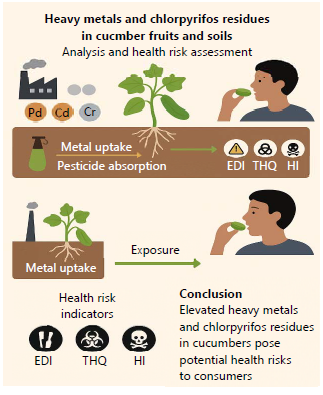
GRAPHICAL ABSTRACT
How to Cite this paper?
APA-7 Style
Ullah,
M.Z. (2026). Analysis of Heavy Metals and Chlorpyrifos Residues in Cucumber Fruits and Agricultural Soils. Trends in Environmental Sciences, 2(2), 134-144. https://doi.org/10.21124/tes.2026.134.144
ACS Style
Ullah,
M.Z. Analysis of Heavy Metals and Chlorpyrifos Residues in Cucumber Fruits and Agricultural Soils. Trends Env. Sci 2026, 2, 134-144. https://doi.org/10.21124/tes.2026.134.144
AMA Style
Ullah
MZ. Analysis of Heavy Metals and Chlorpyrifos Residues in Cucumber Fruits and Agricultural Soils. Trends in Environmental Sciences. 2026; 2(2): 134-144. https://doi.org/10.21124/tes.2026.134.144
Chicago/Turabian Style
Ullah, Mohammad, Zahir.
2026. "Analysis of Heavy Metals and Chlorpyrifos Residues in Cucumber Fruits and Agricultural Soils" Trends in Environmental Sciences 2, no. 2: 134-144. https://doi.org/10.21124/tes.2026.134.144

This work is licensed under a Creative Commons Attribution 4.0 International License.