
Analysis of Heavy Metals and Chlorpyrifos Residues in Cucumber Fruits and Agricultural Soils
-
Mohammad Zahir Ullah


Food Crop Section, Bangladesh Institute of Research and Training on Applied Nutrition (BIRTAN), Head Office, Araihazar, Narayanganj, Bangladesh
| Received 27 Oct, 2025 |
Accepted 18 Jun, 2026 |
Published 30 Jun, 2026 |
Background and Objective: Contamination of food crops by heavy metals and pesticide residues poses a serious public health concern, particularly in intensively cultivated agricultural regions. Cucumbers are widely consumed in Bangladesh, yet data on combined heavy metal and organophosphate pesticide contamination and associated health risks remain limited. This study aimed to quantify lead (Pb), cadmium (Cd), chromium (Cr), and chlorpyrifos residues in cucumber fruits and corresponding agricultural soils from selected upazilas of Bangladesh, and to assess potential non-carcinogenic health risks for consumers. Materials and Methods: Cucumber fruits and associated soil samples were collected from Savar, Araihazar, and Rupganj upazilas. Concentrations of Pb, Cd, and Cr were determined using Atomic Absorption Spectrophotometry, while chlorpyrifos residues were analyzed by Gas Chromatography with Electron Capture Detection. Measured concentrations were compared with international permissible limits set by Codex Alimentarius, WHO/FAO, EU, and US EPA. Human health risks were evaluated using Estimated Daily Intake, Target Hazard Quotient, and Hazard Index approaches based on adult and child exposure scenarios. Data were statistically analyzed using standard descriptive and comparative methods at significant differences (p<0.05). Results: Elevated concentrations of Pb, Cd, and Cr were detected in several cucumber and soil samples, with contamination levels in some cases exceeding international safety limits, particularly in Rupganj and Savar. Chlorpyrifos residues were detected in most samples and remained below Codex and US EPA limits; however, exceedances of the stricter EU maximum residue limit were observed in selected samples. Health risk assessment indicated potential non-carcinogenic risks associated mainly with Cr, Pb, and Cd exposure, with children identified as more vulnerable than adults. Conclusion: The study provides evidence of combined heavy metal and pesticide contamination in cucumbers cultivated in selected regions of Bangladesh, highlighting potential public health risks. Continuous monitoring, improved pesticide management practices, and soil remediation strategies are recommended to reduce dietary exposure. Further studies are needed to evaluate seasonal variation and long-term health impacts associated with chronic consumption of contaminated vegetables.
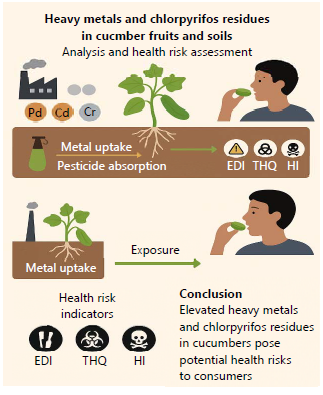
GRAPHICAL ABSTRACT
| Copyright © 2026 Mohammad Zahir Ullah. This is an open-access article distributed under the Creative Commons Attribution License, which permits unrestricted use, distribution, and reproduction in any medium, provided the original work is properly cited. |
INTRODUCTION
The contamination of food crops with heavy metals and pesticide residues poses a serious threat to food safety and human health, particularly in developing countries such as Bangladesh. Heavy metals, including lead (Pb), cadmium (Cd), and chromium (Cr), can accumulate in soils through industrial emissions, wastewater irrigation, fertilizers, and pesticide formulations, and subsequently enter crops via root uptake or surface deposition1,2. Their persistence and non-biodegradable nature make them hazardous to both ecosystems and humans3.
Organophosphate pesticides, such as chlorpyrifos, are commonly applied to vegetables to control insect pests. However, their persistence and neurotoxic effects have raised global concerns, leading to restrictions or bans by the US EPA and EFSA4,5. Chronic exposure to heavy metals and pesticide residues through dietary intake can result in developmental, neurological, and endocrine disorders.
In Bangladesh, intensive agriculture and unregulated pesticide use contribute to the accumulation of both metals and pesticide residues in soils and vegetables6,7. Although previous studies have assessed either heavy metals or pesticide residues, integrated evaluations of both in cucumbers remain limited.
This study investigates Pb, Cd, Cr, and chlorpyrifos residues in cucumber fruits and corresponding soils from Savar, Araihazar, and Rupganj upazilas. Contaminant levels were compared with international permissible limits, and human health risks were evaluated using Estimated Daily Intake (EDI), Target Hazard Quotient (THQ), and Hazard Index (HI) models, providing insights into potential environmental and dietary exposure risks.
MATERIALS AND METHODS
Study area and sampling: Samples were collected from three major vegetable-producing upazilas in Bangladesh: Savar (Dhaka District), Araihazar, and Rupganj (Narayanganj District). These areas were selected due to high agricultural activity, frequent pesticide application, and proximity to industrial zones, increasing contamination risks. The study was conducted over a period of eight months, from March, 2024 to October, 2024. Field sampling was carried out between May and July, 2024, corresponding to the peak cucumber harvesting season in the study areas. Laboratory analyses were completed from July to October 2024. Paired samples of cucumber fruits and corresponding surface soils (0-15 cm) were collected from multiple locations in each upazila. Samples were placed in sterile polyethylene bags, transported in ice boxes, and stored at 4°C until analysis.
Sample preparation: Cucumber fruits were washed, chopped, oven-dried at 60°C until constant weight, and ground into powder. Soil samples were air-dried, sieved (2 mm), and homogenized. Prepared samples were stored in airtight containers before analysis.
Analysis of heavy metals: Approximately 1 g of dried sample was digested with a mixture of HNO3 and HClO4 (3:1 v/v) following USEPA Method 3050B. Pb, Cd, and Cr concentrations were measured using Atomic Absorption Spectrophotometry (Shimadzu AA-7000)8. Analytical accuracy was verified through blanks, duplicates, and recovery tests (92-104%).
Chlorpyrifos analysis: Chlorpyrifos residues were extracted using a modified QuEChERS method and quantified with Gas Chromatography-Electron Capture Detection (Agilent 7890A). Method detection limits ranged from 0.005-0.01 mg/kg, and recovery rates were 85-105%9.
Health risk assessment: Human exposure via cucumber consumption was assessed using EDI, THQ, and HI10:
 |
Where:
| C | = | Concentration of contaminant in cucumber (mg/kg) | |
| IR | = | Average daily vegetable intake (0.238 kg/day for Bangladeshi adults; WHO, 2018) | |
| BW | = | Average body weight (adult = 60 kg, child = 30 kg) |
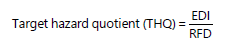 |
Reference doses (RfD, mg/kg/day) from US EPA (2011): Pb = 0.004, Cd = 0.001, Cr (VI) = 0.003, and Chlorpyrifos = 0.001 (Table 1).
THQ<1 indicates negligible risk, while THQ≥1 indicates potential non-carcinogenic risk.
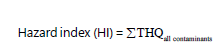 |
HI>1 suggests possible combined health risks from multiple contaminants6.
Statistical analysis: All measurements were performed in triplicate. Data are presented as Mean±SD. One-way ANOVA followed by DMRT was used to determine significant differences (p<0.05) among sampling sites. Pearson correlation analysis was applied to evaluate soil-to-plant transfer relationships.
RESULTS AND DISCUSSION
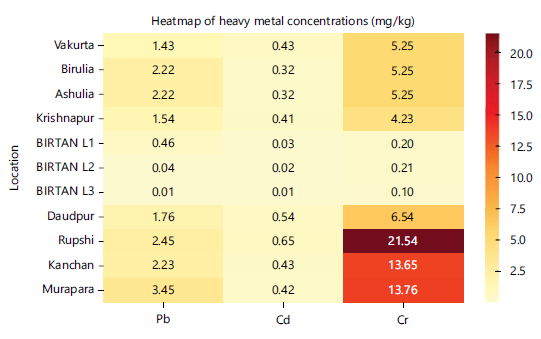
Heavy metal concentrations in cucumber fruits: Cucumber fruits collected from the study areas showed accumulation of heavy metals, with mean concentrations (mg/kg FW) as follows: Pb ranged from 0.013-3.45, Cd from 0.01-0.645, and Cr from 0.098-21.54 (Table 2). The highest concentrations of
|
|
| Table 1: | Permissible limits (WHO/FAO and codex alimentarius)11 | |||
| Metal | Fruits/vegetables (mg/kg) | Agricultural soil (mg/kg) |
| Pb | 0.3-0.5 | 50 |
| Cd | 0.05-0.1 | 3 |
| Cr | 0.1-2.3 | 100 |
| Table 2: | Heavy metals concentration (mg/kg) in cucumber fruit (with DMRT) | |||
| Location | Upazila | Pb (mg/kg)±SD | Cd (mg/kg)±SD | Cr (mg/kg)±SD |
| Vakurta | Savar | 1.43±0.34b | 0.432±0.041b | 5.253±0.23b |
| Birulia | Savar | 2.22±0.13a | 0.315±0.021c | 5.253±0.25b |
| Ashulia | Savar | 2.22±0.13a | 0.315±0.032c | 5.253±0.28b |
| Krishnapur | Savar | 1.54±0.012b | 0.415±0.031b | 4.23±0.13c |
| BIRTAN L1 | Araihazar | 0.456±0.241c | 0.03±0.01d | 0.2±0.062d |
| BIRTAN L2 | Araihazar | 0.045±0.247c | 0.02±0.01d | 0.21±0.062d |
| BIRTAN L3 | Araihazar | 0.013±0.221c | 0.01±0.02d | 0.098±0.034d |
| Daudpur | Rupganj | 1.76±0.712ab | 0.543±0.105a | 6.54±6.13b |
| Rupshi | Rupganj | 2.45±0.754a | 0.645±0.102a | 21.54±6.15a |
| Kanchan | Rupganj | 2.234±0.714a | 0.43±0.150b | 13.65±6.13ab |
| Murapara | Rupganj | 3.45±0.712a | 0.423±0.112b | 13.76±6.17ab |
| Min | 0.013±0.247c | 0.01±0.01d | 0.098±0.062d | |
| Max | 3.45±0.712a | 0.645±0.105a | 21.54±6.13a | |
| Mean | 1.62±1.08 | 0.33±0.22 | 6.91±6.77 | |
| LSD | 0.61 | 0.08 | 1.72 |
Pb and Cd were observed in Rupganj cucumbers (Pb: 2.45-3.45 mg/kg; Cd: 0.423-0.645 mg/kg), whereas the lowest values were recorded in Araihazar cucumbers. Chromium levels were highest in Rupshi (21.54 mg/kg) and lowest in BIRTAN L3 (0.098 mg/kg) (Fig. 2). All measured Pb and Cd concentrations exceeded the Codex Alimentarius limits for vegetables (Pb: 0.1 mg/kg; Cd: 0.05 mg/kg), indicating potential health risks (Table 1)11.
The transfer factor (TF) from soil to fruit followed the order Cd>Pb>Cr, suggesting that cadmium is more readily translocated into the edible portion of cucumbers. This aligns with previous findings that cadmium exhibits high mobility and bioavailability in soils12.
Upazila summary differences were evident (Table 3). Rupganj cucumbers exhibited the highest average levels of Pb (2.48 mg/kg), Cd (0.51 mg/kg), and Cr (13.87 mg/kg), followed by Savar (Pb: 1.84 mg/kg; Cd: 0.38 mg/kg, Cr: 5.50 mg/kg), while Araihazar cucumbers had the lowest concentrations (Pb: 0.17 mg/kg, Cd: 0.02 mg/kg; Cr: 0.17 mg/kg) (Fig. 1). The DMRT analysis indicated that differences among upazilas were statistically significant (p<0.05), with Rupganj showing significantly higher metal accumulation than Araihazar, while Savar was intermediate. The elevated Pb and Cr levels in Savar and Rupganj cucumbers may be attributed to irrigation with contaminated surface water, which facilitates metal uptake through roots and direct deposition on fruit surfaces6.
Heavy metal concentrations in soil samples: The concentrations of Pb, Cd, and Cr in the agricultural soils collected from Savar, Araihazar, and Rupganj are presented in Table 4. Mean concentrations (mg/kg) of the analyzed heavy metals in all sampling sites followed the decreasing order Cr>Pb>Cd, indicating that chromium was the dominant contaminant in the studied soils. Similar distribution patterns of soil metal enrichment were reported13 in industrial and peri-urban agricultural zones of Bangladesh.
| Table 3: | Upazila mean heavy metals concentration (mg/kg) in cucumber fruit | |||
| Upazila | Pb (mg/kg) | Cd (mg/kg) | Cr (mg/kg) |
| Rupganj | 2.48a | 0.51a | 13.87a |
| Savar | 1.84a | 0.38a | 5.50b |
| Araihazar | 0.17b | 0.02b | 0.17c |
| Same letters = statistically similar; different letters = significant difference at 5% level | |||
| Table 4: | Heavy metals concentration (mg/kg) in agricultural soil of cucumber field (with DMRT) | |||
| Location | Upazila | Pb (mg/kg)±SD | Cd (mg/kg)±SD | Cr (mg/kg)±SD |
| Vakurta | Savar | 17.64±1.76a | 1.15±0.12a | 27.71±2.77a |
| Birulia | Savar | 7.98±0.80b | 0.99±0.10a | 23.54±2.35b |
| Ashulia | Savar | 6.92±0.69b | 0.71±0.07b | 21.54±2.15b |
| Krishnapur | Savar | 7.76±0.78b | 0.86±0.09b | 29.65±2.97a |
| BIRTAN L1 | Araihazar | 2.45±0.25c | 0.07±0.31d | 17.65±1.72c |
| BIRTAN L2 | Araihazar | 1.65±0.17c | 0.07±0.01d | 12.65±1.27d |
| BIRTAN L3 | Araihazar | 3.87±0.39c | 0.09±0.04d | 15.45±1.55d |
| Daudpur | Rupganj | 6.54±0.62b | 0.55±0.06c | 32.44±3.24a |
| Rupshi | Rupganj | 5.54±0.55b | 0.57±0.05c | 23.76±2.38b |
| Kanchan | Rupganj | 6.53±0.61b | 0.63±0.23c | 23.65±2.36b |
| Murapara | Rupganj | 5.76±0.58b | 0.54±0.05c | 23.76±2.38b |
| Min | 1.65 | 0.07 | 12.65 | |
| Max | 17.64 | 1.15 | 32.44 | |
| Mean±SD | 6.60±1.61 | 0.56±0.07 | 22.89±2.61 | |
| LSD (0.05) | 1.47 | 0.09 | 2.84 | |
| Values represent mean±standard deviation (n = 3). Different superscript letters (a-d) in each column denote significant differences at p<0.05 according to DMRT. LSD values were derived based on within-group variance estimates and provide the threshold for statistical separation among treatments | ||||
| Table 5: | Upazila mean heavy metals concentration (mg/kg) in agricultural soil of cucumber field | |||
| Upazila | Pb (mg/kg) | Cd (mg/kg) | Cr (mg/kg) |
| Savar | 9.56a | 0.93a | 25.59a |
| Rupganj | 5.83b | 0.57a | 23.88a |
| Araihazar | 2.66c | 0.07b | 15.25b |
Lead (Pb) concentrations varied from 1.65 to 17.64 mg/kg, with the highest value observed at Vakurta (Savar) and the lowest at BIRTAN L2 (Araihazar) (Table 4). Although Pb levels in most samples remained below the FAO/WHO (2016) permissible limit of 50 mg/kg (Table 1), elevated concentrations in Savar soils suggest potential accumulation from nearby industrial and vehicular sources14.
Cadmium (Cd) concentrations ranged from 0.07 to 1.15 mg/kg, with the maximum detected at Vakurta (Savar) and the minimum in BIRTAN L2 (Araihazar) (Table 4). While Cd levels were relatively low, they exceeded the safe guideline value (0.8 mg/kg) in several locations, indicating possible contamination from fertilizers, wastewater irrigation, or agrochemicals.
Chromium (Cr) concentrations were comparatively high, ranging between 12.65 and 32.44 mg/kg, with the highest levels recorded at Daudpur (Rupganj) and Krishnapur (Savar) (Table 4). The Cr contents in several sites exceeded the recommended limit of 30 mg/kg for agricultural soils, suggesting contamination likely derived from tannery effluents and industrial discharges.
Spatial variation in soil heavy metal concentrations was clearly observed among the three studied upazilas (Table 5). The highest mean lead (Pb) concentration was recorded in Savar (9.56 mg/kg), followed by Rupganj (5.83 mg/kg), while the lowest level was found in Araihazar (2.66 mg/kg). A similar trend was observed for cadmium (Cd), where Savar showed the highest mean concentration (0.93 mg/kg), followed by Rupganj (0.57 mg/kg), whereas Araihazar exhibited a significantly lower value (0.07 mg/kg). For chromium (Cr), Savar again showed the highest mean concentration (25.59 mg/kg), closely followed by Rupganj (23.88 mg/kg), while Araihazar recorded the lowest level (15.25 mg/kg). Statistical analysis using DMRT indicated that Pb concentrations in Savar were significantly higher than those in Rupganj and Araihazar (p<0.05), whereas Cd and Cr levels in Savar and Rupganj were statistically similar but significantly higher than those in Araihazar. The elevated heavy metal concentrations in Savar and Rupganj soils, particularly for Pb and Cr, may be attributed to their proximity to industrial estates, tannery operations, and metal-processing activities, which contribute to environmental metal loading. In contrast, the comparatively lower concentrations observed in Araihazar suggest reduced industrial influence, although the presence of trace metals may still be associated with long-term agricultural practices such as the use of phosphate fertilizers, pesticides, and irrigation inputs3,12.
Chlorpyrifos residues in cucumber fruit samples: The concentration of chlorpyrifos detected in cucumber fruit samples from different locations is presented in Table 6. Residue levels ranged from non-detectable (0.00 mg/kg) to 0.130 mg/kg, with the highest concentration observed at Rupshi (Rupganj) and the lowest at BIRTAN L1 (Araihazar). The overall mean chlorpyrifos concentration across all sampling sites was approximately 0.094 mg/kg (Table 6).
| Table 6: | Chlorpyrifos concentration (mg/kg) in cucumber fruit | |||
| Location | Upazila | Chlorpyrifos |
| Vakurta | Savar | 0.123 |
| Birulia | Savar | 0.118 |
| Ashulia | Savar | 0.113 |
| Krishnapur | Savar | 0.116 |
| BIRTAN L1 | Araihazar | 0 |
| BIRTAN L2 | Araihazar | 0.021 |
| BIRTAN L3 | Araihazar | 0.068 |
| Daudpur | Rupganj | 0.116 |
| Rupshi | Rupganj | 0.13 |
| Kanchan | Rupganj | 0.125 |
| Murapara | Rupganj | 0.11 |
| Average | 0.094 |
Cucumber fruits collected from Savar and Rupganj upazilas exhibited relatively higher chlorpyrifos residues (0.113-0.130 mg/kg), while samples from Araihazar showed markedly lower or negligible levels (0.00-0.068 mg/kg). The elevated residues in Savar and Rupganj may be attributed to more frequent pesticide application practices and shorter pre-harvest intervals in these intensive vegetable-growing areas. Similar spatial trends were reported15,16, who found higher organophosphate residues in vegetables cultivated near peri-urban farming zones with high pesticide dependence.
The detected concentrations were below the Codex Alimentarius maximum residue limit (MRL = 0.5 mg/kg) for cucumbers16, indicating that, although chlorpyrifos use is evident, the residues are within internationally accepted safety thresholds. However, the presence of detectable residues in most samples suggests non-uniform pesticide management and possible non-compliance with good agricultural practices (GAP). Continuous monitoring is therefore recommended to prevent accumulation from repeated applications and to ensure consumer safety.
Chlorpyrifos concentration in agricultural soil of cucumber field: The concentrations of chlorpyrifos detected in agricultural soils collected from cucumber fields across three upazilas are summarized in Table 7. Chlorpyrifos residues ranged from below the limit of quantification (BLQ, <0.01 mg/kg) to 0.048 mg/kg, with the highest value recorded at Birulia (Savar) and the lowest at BIRTAN L2 and L3 (Araihazar). The overall mean concentration was approximately 0.042 mg/kg, indicating low but detectable levels of organophosphate contamination in most sites (Table 7).
Soil samples from Savar and Rupganj generally exhibited higher chlorpyrifos residues (0.042-0.048 mg/kg) compared to Araihazar, where residues were minimal or below the quantification limit. This pattern corresponds with the higher intensity of pesticide usage in Savar and Rupganj, where cucumbers are cultivated year-round under intensive production systems. Similar findings were reported by other studies7,8, who observed elevated organophosphate residues in soils of vegetable-growing belts surrounding industrial and peri-urban zones.
Although all detected chlorpyrifos concentrations were below the permissible limit for agricultural soils (0.13 mg/kg)14, their presence suggests recent pesticide application and possible persistence due to repeated use or limited microbial degradation under field conditions (Table 8). The residues in soil serve as a potential source of uptake by cucumber plants, as supported by the corresponding detection of chlorpyrifos in fruit samples.
| Table 7: | Chlorpyrifos (mg/kg) concentration in agricultural soil of cucumber field | |||
| Location | Upazila | Chlorpyrifos |
| Vakurta | Savar | 0.047 |
| Birulia | Savar | 0.048 |
| Ashulia | Savar | 0.043 |
| Krishnapur | Savar | 0.042 |
| BIRTAN L1 | Araihazar | 0.041 |
| BIRTAN L2 | Araihazar | BLQ, [LOQ-0.01] |
| BIRTAN L3 | Araihazar | BLQ, [LOQ-0.01] |
| Daudpur | Rupganj | 0.043 |
| Rupshi | Rupganj | 0.03 |
| Kanchan | Rupganj | 0.045 |
| Murapara | Rupganj | 0.046 |
| Average | 0.042 |
| Table 8: | Pesticides residue compliance status | |||
| Crop | Maximum residue detected (mg/kg) |
Codex MRL (mg/kg) |
EU MRL (mg/kg) |
US EPA MRL (mg/kg) |
Compliance status |
| Cucumber | 0.13 | 0.5 | 0.05 | 0.5 | Exceeds EU limit only |
| MRL: Maximum residue limit, Codex: Codex alimentarius commission, EU: European union and US EPA: United States environmental protection agency | |||||
| Table 9: | Concentration of EDI, THQ and HI for Rupganj | |||
| Contaminant | Conc. (mg/kg) | EDI-Adult | THQ-Adult | EDI-Child | THQ-Child |
| Pb | 2.48 | 0.009837 | 2.459 | 0.019675 | 4.919 |
| Cd | 0.51 | 0.002023 | 2.023 | 0.004046 | 4.046 |
| Cr | 13.87 | 0.055018 | 18.339 | 0.110035 | 36.678 |
| Chlorpyrifos | 0.12025 | 0.000477 | 0.477 | 0.000954 | 0.954 |
| HI (sum THQs) | - | - | 23.299 | - | 46.597 |
| EDI: Estimated daily intake, THQ: Target hazard quotient, HI: Hazard index (ΣTHQs for all contaminants). Pb: Lead, Cd: Cadmium, Cr: Chromium. Chlorpyrifos is an organophosphate pesticide. All values are unitless except contaminant concentration (mg/kg). HI represents the cumulative non-carcinogenic health risk from combined exposure to all contaminants. A THQ or HI value >1 indicates potential health risk. Calculations are based on standard USEPA exposure assessment models for adult and child populations | |||||
The detection of BLQ values in Araihazar sites (BIRTAN L2 and L3) may reflect either controlled pesticide management practices or effective degradation resulting from lower pesticide input and favorable soil conditions (e.g., higher organic matter and microbial activity) (Table 7). Continuous monitoring and training on safe pesticide handling and application intervals are recommended to prevent buildup and ensure sustainable crop production.
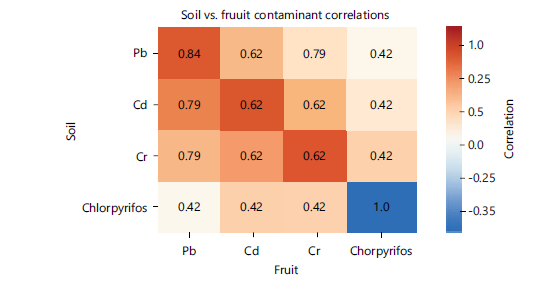
Correlation between soil and fruit contamination: Pearson correlation analysis revealed significant positive correlations between soil and cucumber concentrations of Pb (r = 0.84, p<0.01) and Cd (r = 0.79, p<0.05) (Fig. 2). These strong relationships indicate direct transfer of metals from soil to plants, consistent with soil-to-plant bioaccumulation models2. For Chlorpyrifos, a weaker correlation (r = 0.42) was observed, likely due to its surface adsorption characteristics and rapid degradation under sunlight (Eaton et al.4). These findings highlight that soil contamination is a key determinant of vegetable safety and underscores the need for soil quality monitoring and remediation measures in intensive farming zones.
Health risk assessment: The human health risk assessment was conducted based on the Estimated Daily Intake (EDI), Target Hazard Quotient (THQ), and Hazard Index (HI) values for adults and children consuming cucumber fruits from the three study upazilas-Rupganj, Savar, and Araihazar. The EDI values for Pb, Cd, Cr, and chlorpyrifos in all locations were compared with their respective reference doses (RfD). Although individual EDI values were generally low, the calculated THQ and HI values indicated potential non-carcinogenic health risks, particularly from chromium (Cr), cadmium (Cd), and lead (Pb).
In Rupganj, the THQ values for adults were 2.459 (Pb), 2.023 (Cd), 18.339 (Cr), and 0.477 (chlorpyrifos), yielding a cumulative HI of 23.299. For children, THQs were 4.919 (Pb), 4.046 (Cd), 36.678 (Cr), and 0.954 (chlorpyrifos), with a total HI of 46.597 (Table 9). Both adult and child HI values greatly exceeded the safety threshold of 1, indicating a significant non-carcinogenic health risk, dominated by Cr, followed by Pb and Cd. Children were approximately twice as vulnerable as adults due to lower body weight and higher intake per kilogram body mass. At Savar, the adult THQs were 1.825 (Pb), 1.507 (Cd), 7.272 (Cr), and 0.466 (chlorpyrifos), resulting in a total HI of 11.070. For children, THQs were 3.649 (Pb), 3.015 (Cd), 14.544 (Cr), and 0.932 (chlorpyrifos), with a total HI of 22.141 (Table 10). The HI values again exceeded unity, demonstrating potential adverse health effects, particularly from chromium and lead exposure. Similar to Rupganj, the cumulative risk was notably higher for children.
In contrast, the mean contaminant concentrations in Araihazar cucumbers were much lower. The adult THQs were 0.169 (Pb), 0.079 (Cd), 0.225 (Cr), and 0.118 (chlorpyrifos), resulting in an HI of 0.590-below the threshold of 1, suggesting no significant health risk for adults (Table 11). However, children had slightly higher THQs of 0.337 (Pb), 0.159 (Cd), 0.450 (Cr), and 0.235 (chlorpyrifos), giving an HI of 1.181, which slightly exceeds the safety limit and implies possible health concern for children. The results show that Rupganj and Savar pose considerable non-carcinogenic health risks to both adults and children due to elevated Cr, Pb, and Cd levels in cucumber fruits, while Araihazar presents relatively lower risk. Chromium contributed the most to overall hazard indices across all sites, indicating industrial or tannery-related contamination as a likely source. Chlorpyrifos residues alone did not exceed the acceptable limit (THQ<1), but their cumulative contribution increased the overall HI values in contaminated areas.
| Table 10: | Concentration of EDI, THQ and HI for Savar | |||
| Contaminant | Conc. (mg/kg) | EDI-Adult | THQ-Adult | EDI-Child | THQ-Child |
| Pb | 1.84 | 0.007299 | 1.825 | 0.014597 | 3.649 |
| Cd | 0.38 | 0.001507 | 1.507 | 0.003015 | 3.015 |
| Cr | 5.5 | 0.021817 | 7.272 | 0.043633 | 14.544 |
| Chlorpyrifos | 0.1175 | 0.000466 | 0.466 | 0.000932 | 0.932 |
| HI (sum THQs) | - | - | 11.07 | - | 22.141 |
| EDI: Estimated daily intake, THQ: Target hazard quotient, HI: Hazard index (ΣTHQs for all contaminants). Pb: Lead, Cd: Cadmium, Cr: Chromium. Chlorpyrifos is an organophosphate pesticide. All values are unitless except contaminant concentration (mg/kg). HI represents the cumulative non-carcinogenic health risk from combined exposure to all contaminants. A THQ or HI value >1 indicates potential health risk. Calculations are based on standard USEPA exposure assessment models for adult and child populations | |||||
| Table 11: | Concentration of EDI, THQ and HI for Araihazar | |||
| Contaminant | Conc. (mg/kg) | EDI-Adult | THQ-Adult | EDI-Child | THQ-Child |
| Pb | 0.17 | 0.000674 | 0.169 | 0.001349 | 0.337 |
| Cd | 0.02 | 0.000079 | 0.079 | 0.000159 | 0.159 |
| Cr | 0.17 | 0.000674 | 0.225 | 0.001349 | 0.45 |
| Chlorpyrifos | 0.02967 | 0.000118 | 0.118 | 0.000235 | 0.235 |
| HI (sum THQs) | - | - | 0.59 | - | 1.181 |
| EDI: Estimated daily intake, THQ: Target hazard quotient, HI: Hazard index (ΣTHQs for all contaminants). Pb: Lead, Cd: Cadmium, Cr: Chromium. Chlorpyrifos is an organophosphate pesticide. All values are unitless except contaminant concentration (mg/kg). HI represents the cumulative non-carcinogenic health risk from combined exposure to all contaminants. A THQ or HI value >1 indicates potential health risk. Calculations are based on standard USEPA exposure assessment models for adult and child populations | |||||
The HI values for children were consistently higher than those for adults, highlighting greater vulnerability in the younger population due to lower body weight and higher relative food consumption rates. Therefore, regular monitoring and mitigation strategies are urgently needed to minimize exposure to heavy metals and pesticide residues in food crops cultivated in these regions.
Comparison with previous studies: Compared to other studies in Bangladesh, metal concentrations in this study were comparable or slightly higher. For example, Islam et al.3 reported mean Pb levels of 0.85 mg/kg and Cd levels of 0.25 mg/kg in leafy vegetables from Dhaka, Cd levels up to 0.41 mg/kg in root crops. Chlorpyrifos residues in the present study were lower than those reported by Momtaz and Khan15, suggesting possible variability in pesticide use intensity across regions. Overall, the results reinforce the trend of combined chemical exposure in food crops, with both legacy industrial pollution and ongoing pesticide misuse contributing to cumulative health risks in Bangladesh’s agroecosystems.
CONCLUSION
This study revealed that both heavy metals (Pb, Cd, Cr) and Chlorpyrifos pesticide residues are present in cucumber fruits and their corresponding agricultural soils collected from Savar, Araihazar, and Rupganj upazilas of Bangladesh. The concentrations of Pb, Cd, and Cr in both soil and fruit samples frequently exceeded international permissible limits set by WHO/FAO and Codex Alimentarius, indicating substantial contamination. Chlorpyrifos residues were also detected in measurable amounts, with some cucumber samples exceeding the stringent EU Maximum Residue Limit (MRL), though most were within Codex and US EPA limits. Health risk assessments based on Estimated Daily Intake (EDI), Target Hazard Quotient (THQ), and Hazard Index (HI) showed HI values greater than 1 in most sampling locations, suggesting potential non-carcinogenic health risks to consumers through long-term exposure. The highest contamination and risk values were observed in Savar and Rupganj, reflecting possible links to intensive pesticide use and industrial proximity. Overall, the findings indicate that agricultural soils act as a significant reservoir for heavy metals and persistent pesticide residues, facilitating their transfer to food crops and posing long-term environmental and public health risks.
SIGNIFICANCE STATEMENT
This study provides a comprehensive assessment of both heavy metal (Pb, Cd, Cr) and chlorpyrifos contamination in cucumber fruits and associated agricultural soils from major vegetable-producing regions of Bangladesh. By integrating chemical analysis with human health risk assessment models (EDI, THQ, and HI), the study highlights the potential non-carcinogenic risks to consumers, particularly children. The findings reveal that industrial proximity and intensive agricultural practices significantly contribute to contaminant accumulation in food crops. This work offers important insights for policymakers, food safety authorities, and agricultural stakeholders to implement effective monitoring, pesticide regulation, and soil remediation strategies, thereby ensuring safer food production and reducing public health risks.
REFERENCES
- Alloway, B.J., 2013. Heavy Metals in Soils: Trace Metals and Metalloids in Soils and their Bioavailability. 3rd Edn., Springer, New York, USA, ISBN-13: 9789400744691, Pages: 614.
- Kabata-Pendias, A., 2011. Trace Elements in Soils and Plants. 4th Edn., CRC Press, Boca Raton, Florida, ISBN-13: 9781420093681, Pages: 520.
- Saiful Islam, M., M.K. Ahmed, M. Raknuzzaman, M. Habibullah-Al-Mamun and M. Kamrul Islam, 2015. Heavy metal pollution in surface water and sediment: A preliminary assessment of an urban river in a developing country. Ecol. Indic., 48: 282-291.
- Kim, K.H., Ehsanul Kabir and S.A. Jahan, 2017. Exposure to pesticides and the associated human health effects. Sci. Total Environ., 575: 525-535.
- Tudi, M., H.D. Ruan, L. Wang, J. Lyu and R. Sadler et al., 2021. Agriculture development, pesticide application and its impact on the environment. Int. J. Environ. Res. Public Health, 18.
- Cui, Y.J., Y.G. Zhu, R.H. Zhai, D.Y. Chen, Y.Z. Huang, Y. Qiu and J.Z. Liang, 2004. Transfer of metals from soil to vegetables in an area near a smelter in Nanning, China. Environ. Int., 30: 785-791.
- Alam, M.G.M., E.T. Snow and A. Tanaka, 2003. Arsenic and heavy metal contamination of vegetables grown in Samta Village, Bangladesh. Sci. Total Environ., 308: 83-96.
- Khan, S., Q. Cao, Y.M. Zheng, Y.Z. Huang and Y.G. Zhu, 2008. Health risks of heavy metals in contaminated soils and food crops irrigated with wastewater in Beijing, China. Environ. Pollut., 152: 686-692.
- Anastassiades, M., S.J. Lehotay, D. Stajnbaher and F.J. Schenck, 2003. Fast and easy multiresidue method employing acetonitrile extraction/partitioning and “dispersive solid-phase extraction” for the determination of pesticide residues in produce. J. AOAC Int., 86: 412-431.
- Ali, H., E. Khan and I. Ilahi, 2019. Environmental chemistry and ecotoxicology of hazardous heavy metals: Environmental persistence, toxicity, and bioaccumulation. J. Chem., 2019.
- Nagajyoti, P.C., K.D. Lee and T.V.M. Sreekanth, 2010. Heavy metals, occurrence and toxicity for plants: A review. Environ. Chem. Lett., 8: 199-216.
- Peralta-Videa, J.R., M.L. Lopez, M. Narayan, G. Saupe and J.G. Torresdey, 2009. The biochemistry of environmental heavy metal uptake by plants: Implications for the food chain. Int. J. Biochem. Cell Biol., 41: 1665-1677.
- Sultana, R., R.U. Tanvir, K.A. Hussain, A.S. Chamon and M.N. Mondol, 2022. Heavy metals in commonly consumed root and leafy vegetables in Dhaka City, Bangladesh, and assessment of associated public health risks. Environ. Syst. Res., 11.
- FAO and WHO, 2016. Pesticide Residues in Food-2016: Toxicological Evaluations. World Health Organization, Rome, Italy, ISBN: 9789241655323, Pages: 480.
- Momtaz, M. and M.S. Khan, 2024. Analysis of chlorpyrifos pesticide residue in locally grown cauliflower, cabbage, and eggplant using gas chromatography-mass spectrometry (GC-MS) technique: A Bangladesh perspective. Foods, 13.
- Rani, L., K. Thapa, N. Kanojia, N. Sharma and S. Singh et al., 2021. An extensive review on the consequences of chemical pesticides on human health and environment. J. Cleaner Prod., 283.
How to Cite this paper?
APA-7 Style
Ullah,
M.Z. (2026). Analysis of Heavy Metals and Chlorpyrifos Residues in Cucumber Fruits and Agricultural Soils. Trends in Environmental Sciences, 2(2), 134-144. https://doi.org/10.21124/tes.2026.134.144
ACS Style
Ullah,
M.Z. Analysis of Heavy Metals and Chlorpyrifos Residues in Cucumber Fruits and Agricultural Soils. Trends Env. Sci 2026, 2, 134-144. https://doi.org/10.21124/tes.2026.134.144
AMA Style
Ullah
MZ. Analysis of Heavy Metals and Chlorpyrifos Residues in Cucumber Fruits and Agricultural Soils. Trends in Environmental Sciences. 2026; 2(2): 134-144. https://doi.org/10.21124/tes.2026.134.144
Chicago/Turabian Style
Ullah, Mohammad, Zahir.
2026. "Analysis of Heavy Metals and Chlorpyrifos Residues in Cucumber Fruits and Agricultural Soils" Trends in Environmental Sciences 2, no. 2: 134-144. https://doi.org/10.21124/tes.2026.134.144

This work is licensed under a Creative Commons Attribution 4.0 International License.